WHO IS RESPONSIBLE?????
 THE RAGWORT IS TOTALLY OUT OF CONTROL IN THE UK.
 TIME TO COMPLAIN....WHO IS NOT DOING THEIR JOB???
I spend hundreds of hours driving through this pleasant & green land. One can’t help but see & feel the beauty of this Agricultural (industrial) landscape that is rural Great Britain.
However over summer this beautiful landscape is ruined by the disgusting sight of “out of control” Ragwort on the Motorways, public roads, the rail network & even in the towns & cities.
It makes me feel sick inside. It seems nobody gives a damn!
Ragwort is a noxious weed. Who is responsible?????
Common Ragwort used to be rarely seen because farmers would not tolerate it. Even the Daily Telegraph reported
“The change from rarity to infestation (….of Ragwort) reflects a fundamental change in Britain: from a society with a strong rural culture and understanding to a country dominated by urban values”
Ragwort can be highly dangerous to grazing animals including cattle. Every Ragwort plant has up to 150,000 seeds which can remain viable for up to 20 years. Seeds can be blown in the wind up to 100 m.
Natural England is responsible for enforcing the Weeds Act 1959 http://www.naturalengland.org.uk/ourwork/regulation/wildlife/enforcement/injuriousweeds.aspx & the Ragwort Control Act 2003. http://archive.defra.gov.uk/wildlife-pets/wildlife/management/weeds/pdf/cop_ragwort.pdf
Why are they doing absolutely nothing about this outrage?
There is an army of bureaucrats snooping in the name of GB’s farming’s red tape, so why aren’t they waging war on those public authorities allowing ragwort to grow out of control. Ragwort is a serious threat to pasture based grazing farms.
Who's responsible for roadside weeds? The control of roadside vegetation, including common ragwort, is the responsibility of the Highways Agency in the case of motorways and other trunk roads, and the local highway authority, e.g. County Councils, in respect of all other public roads.
However over summer this beautiful landscape is ruined by the disgusting sight of “out of control” Ragwort on the Motorways, public roads, the rail network & even in the towns & cities.
It makes me feel sick inside. It seems nobody gives a damn!
Ragwort is a noxious weed. Who is responsible?????
Common Ragwort used to be rarely seen because farmers would not tolerate it. Even the Daily Telegraph reported
“The change from rarity to infestation (….of Ragwort) reflects a fundamental change in Britain: from a society with a strong rural culture and understanding to a country dominated by urban values”
Ragwort can be highly dangerous to grazing animals including cattle. Every Ragwort plant has up to 150,000 seeds which can remain viable for up to 20 years. Seeds can be blown in the wind up to 100 m.
Natural England is responsible for enforcing the Weeds Act 1959 http://www.naturalengland.org.uk/ourwork/regulation/wildlife/enforcement/injuriousweeds.aspx & the Ragwort Control Act 2003. http://archive.defra.gov.uk/wildlife-pets/wildlife/management/weeds/pdf/cop_ragwort.pdf
Why are they doing absolutely nothing about this outrage?
There is an army of bureaucrats snooping in the name of GB’s farming’s red tape, so why aren’t they waging war on those public authorities allowing ragwort to grow out of control. Ragwort is a serious threat to pasture based grazing farms.
Who's responsible for roadside weeds? The control of roadside vegetation, including common ragwort, is the responsibility of the Highways Agency in the case of motorways and other trunk roads, and the local highway authority, e.g. County Councils, in respect of all other public roads.
 The Weeds Act 1959 provides for the serving of a notice on the occupier of land when ragwort is present and is deemed to be a nuisance — the offence occurs when there is a failure to comply with such a notice.
The presence of ragwort, however dense, is not a problem in itself unless it is in danger of causing a nuisance by spreading to neighbouring land. (I think this is an appalling weakness in the regulations)
The Ragwort Control Act 2003 defines an infestation as being of high risk when it is present and flowering or seeding within 50m of land used for grazing by horses and other animals or land used for feed or forage production. At 50-100m distance the infestation would be classed as of medium risk, and of low risk when at a distance greater than 100m.
I suggest you complain
Telephone: 0845 6003078 or 0114 2418920 Website: www.naturalengland.org.uk
Telephone: 08457 50 40 30 website: www.highways.gov.uk
 DON’T TRASH OUR FARMS
Why in England do people regularly trash the landscape with litter? I don’t understand the mentality of the litterer! Day after day near my village (& probably your village & your farm) litter is dropped from passing cars & vans.
Do these people realise that not only do they trash my (& their) living environments but they put at risk farm animals & farmers. Dairy cows are curious creatures that will play with trash not realising that plastic can endanger their lives. Farm machinery will change a beer can into dangerous metal for farm staff & dairy cows.
 By walking regularly sadly you see the local area trashed daily…by whom? Well does the fact that a very high percentage of the rubbish includes: - beer & coke cans, McDonalds, cigarettes & the Sun Newspaper give us any hints???????
 The countryside & the landscape is one issue but farms are OUR OFFICE, OUR WORKPLACE & OUR HOMES……STOP littering OUR FARMS.
Current UK Pasture Measurements
Pasture growth still very variable dependant on rain. Some spring like growth in Northern Ireland & the south of England. Eastern counties struggling still. However big improvement generally with pasture growth & average Farm Cover. The grass based organic farms have slow growth rates & relatively low covers. Some organic farms have NOT yet cut any silage off the grazing platform.Keep grazing rotations long as we are now entering summer with soil that is still dry for this time of year.
TheAverage Pasture Cover (kgsDM/ha) & Pasture Growth (kgsDM/ha/day)
Portaferry,Nth Ireland,AFC 2130, growth 71kgs/ha/day, after 2 weeks of rain
South Ayrshire, Scotland, 2324, gr72, soil temps 15.3 degrees
Portaferry,Nth Ireland,AFC 2130, growth 71kgs/ha/day, after 2 weeks of rain
South Ayrshire, Scotland, 2324, gr72, soil temps 15.3 degrees
Dumfries, Scotland, AFC 2080, growth 64
North Wales, AFC 1950, gr 44, demand 55
North Wales, AFC 1970, gr 67kgs
Cheshire organic, 2100, growth 30
Shropshire organic, 1764,gr 33 (ouch) cutting lots but growth now
Shropshire, 2100, gr 65, so magic day is here again!!!!
Derbyshire, AFC 2231, growth 58, demand 61
Staffordshire, 2415, gr 64, de 49, reasonable rain last 10 days
East Staffordshire, 2160, growth 50, cutting 9% of farm today
Nottingham, growth 40, demand 60 feeding maize rain showers okay til mid July
Oxford, 2350, gr 40, 30 day round,grass Q not good, still cracks in dry soil
Gloucestershire, 2137, gr87, demand 63, 20% of platform taken out for silage
Dorset AFC 2300, growth 122
Dorset organic, 2100, growth 39, topping
Dorset, 2427, gr61, 45 day grazing rotation
Dorset, 2350, gr 75, milk, M/solids & cow condition all improving since rain
East Sussex, 2004, growth 65, grass in some order now
Devon, 2250, gr67, demand 50
Devon, 2250, growth 64
Cornwall, AFC 2100, growth 85
Flensburg, Northern Germany,organic, AFC 1890, growth 49, 32 day grazing rotation, some rain & improvement in situation


 Andre Voisin
 Chicory & Plantain Herbal Pastures


 Darwin estimated that a healthy English acre ought to have about 2,500,000 worms, turning out 18 tons of casts a year.There should as a rule of thumb be at least


 Under good dairy pastures & sound grazing management is usually a healthy soil environment. Permanent pastures encourage build ups of Soil Organic Matter & healthy soil life. However all that happens on UK low input dairy farms does not favour a healthy soil. E.g. excessive use of Nitrogen, poor drainage, poor use of manures or cultivation/ploughing.
 During & post WW2, Winston Churchill ordered as much of the UK that could be ploughed should be so that arable crops could be grown to feed the nation. The response & the efforts of farmers fed the nation, the right call at the time. Ploughing & cultivation however increases the potential loss of topsoil & destroys the soil structure & certainly speeds up the loss of soil organic matter. These are serious issues to be addressed by the arable industries but pasture farmers need to take heed too.


 The Smart meter graph shows when the energy saving devices were installed.
 You can see the impact of the very cold weather last December when heating & hot water effectively doubled demand during milking. So it's up to you which generation option you chose but you also need to deal with reducing peak demand.
  .
. 
 These are on south facing roofs. The photovoltaic system has an expected 25 yr life with a small reduction in efficiency over that time. To date he has generated more electricity than he has consumed at the milking parlour. (2534kwh produced & 2304kwh consumed).There is a long term guaranteed contract for the feed in tariff currently approx 32p/kwh which is inflation indexed. His current cost of National grid electricity is 10.86/day & 6.22/night. There is an approx 10 year payback on current prices but rapid inflation of energy prices should substantially reduce the payback period.
 What
What 


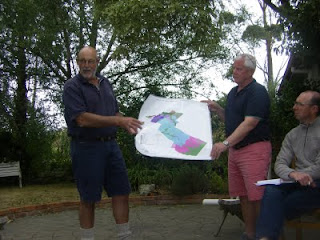 Shane had a very clear long term environmental plan to improve the sustainability of their farm business based on having a soil capability map.
  We need to move away from thinking that ryegrass/clover is our only option especially on dry soils. It may not be our best option to increase soil organic matter (SOM) either so we need to start looking outside the box.