Showing posts with label Pasture Discussion Groups. Show all posts

Sunday, 8 September 2013

Moumahaki Experimental Farm. A Controversial Start to Agricultural Extension in New Zealand


I’ve discovered Moumahaki Experimental Farm est.(1892) in South Taranaki, New Zealand. 

A fascinating story of how Research & Demonstration Farms started in New Zealand. It’s what happens when you are left alone and get lost in a book shop! A weekend discovery gem!

This is part of my history. 

I’ve worked as an Agricultural Scientist in Extension and Dairy Farm Consultancy with farmers in NZ, Australia, Taiwan, UK, Ireland and France visiting research and demonstration farms, all my working life. 

For 33 years the Experimental Farm at Moumahaki was a jewel in the crown of the farming industry. Today we debate the merits, funding and roles of these farms just as they did in the 1890s. 
These farms need to take risks, set big targets and go far beyond the practices of the day. They will be criticised and lambasted by non-believers, the unconvinced and the funders. 
Through challenging the thinking of the day, ignoring the boundaries, imagining the future and good science they progress agriculture forward. Moumahaki really did it  in the most extraordinary manner.

Over 2000 farmers visited the Moumahaki Experimental Farm each year to view the research & farm systems being tried on the state run property. Most travelled by train.
Today there is little evidence left of this historic site. (See photos.)

They arrived at the Moumahaki Railhead, were picked up by the farm staff, given dinner then walked over the farm listening to the manager explaining the research results. 

Groups of up to 200 arrived by train. Some like the Feilding A & P farmers came annually to visit & learn. Dairy Farm Discussion Groups still travel together to learn together.....perhaps not by train so much today!

The farm had four distinct purposes- demonstration, experimental, scientific and educational according to Laraine Sole’s book “Moumahaki Experimental farm”. 
The initial 300 acres (120ha) consisted of poor pasture and bush, some good flats & some very steep sidings with a river frontage. The first Manager was Francis Gillanders from Scotland.
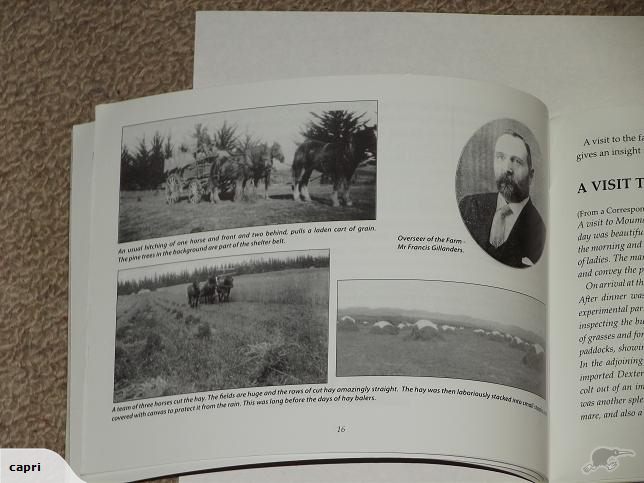

Mr Francis Gillanders set about to establish an experimental farm that included dairy cows (Ayrshires), beef, sheep, pigs, poultry, potatoes, arable, vegetables, fruit (apples, pears, grapes & even pineapples). Early experiments included pasture establishment, hedgerows and the use of different fertilizers at varying rates. Breeding trials (with imported selected livestock) were conducted with Kerry Dexter cross cattle, Shire and Clydesdale horses, Ryland sheep, Strawberries, Mangolds, Swedes and Kale varieties.

Mr Gillanders is quoted as saying 
" The public have a right to criticise, and it is only to be expected that they will do so; but with all due respect to some of the critics, they might get a little more authentic information on the subject before attacking what they evidently know next to nothing about". 
Agricultural research funding & extension was obviously alive and well even back then in the 1890s. I'm starting to like this guy!

Experts touted the farm as “the farmers’ laboratory”. The history of Moumahaki Experimental Farm is truly amazing!


Moumahaki Experimental Farm was the very first in NZ. Few farmers or advisors have heard about this remarkable farm. Located in South Taranaki, north of Waitotara, in New Zealand it was the first State Experimental Farm established by the new NZ Department of Agriculture in 1892.

There was an “Agricultural & Pastoral Conference” at Christchurch in 1892 attended by A & P Show representatives from all over NZ.

 They moved “that in the opinion of this conference the establishment of a properly equipped expert agricultural department is urgently required in NZ. That although there was a Department of Agriculture there was no official in a responsible position who could give advice and assistance to settlers” A petition was sent to Parliament demanding action.
From the early 1870s there was considerable discussion, in newspapers and elsewhere, about the necessity of scientific and technical education for farmers. There were numerous commissions, reports and intense debates about how to establish a formal system of agricultural education. Lincoln Agricultural College was established in 1880 and Massey Agricultural College in 1926.
The 1892 A&P conference had recommended that the department provide farmers with scientific information. The departmental response was to establish experimental farms (one (Moumahaki Experimental Farm) near Waverley in Taranaki and one at Waerenga (Te Kauwhata) in the Waikato in the 90s and 7 more by 1910 including Ruakura (1901)).


The state of thinking at this time is reflected in the Governor’s speech on the opening of Parliament in August 1906, "My advisors deem it advisable to encourage the application of scientific methods to productive processes in order that our farmers may successfully meet the increasing competition from other countries. Though much has been accomplished in this direction, much yet remains to be done" (Parliamentary Debates 1906).

So began Agricultural Extension and Experimental Farms for research and demonstration in New Zealand.

Sunday, 10 March 2013

On a Pasture based Dairy Farm The Sky is Always Blue


The sky is always blue! This is NOT a reference to the lack of rain in Australia & New Zealand. The dairy industry is a place of optimism and opportunities. In every crisis there is both danger and opportunities. The key is to see the opportunity! Believe me the sky is always blue! Pasture based dairy farming is a place of optimism!

Every time I fly the sky is always blue! From the ground it may not seem to be. It’s easy to get pessimistic. Even as the aircraft takes off you are not absolutely sure. But it is always very reassuring to experience that joy of breaking through the clouds. Dark as the clouds might seem. The sky is always blue!  The sky is always blue is a glass half full attitude!

The Chinese symbol for crisis cleverly includes both danger and opportunity. Don’t dismiss the danger and the threats but look for the upside risk, the opportunities to learn, to make decisive moves and to benefit from a crisis.

The world seems to be having these extreme weather events. Remember the 2012 drought in the USA & Canada. 2012 delivered endless rain and mud in the UK, making pasture management a nightmare. The hot dry summer of 2013 in NZ & Australia is now creating desperate feed shortages on most dairy farms. Farmers have little control over these events but there impact can be massive.

There is a huge risk that these events can be very costly. Beware of over spending on feed. Rather look to minimise the losses. Few people make money during dry periods but many lose money. Think ahead. What are you going to do when it does rain? How can you recover quickly with no carry over costs e.g. under feeding calves so that heifers are under target weights…..these carry over costs can impact 2-3 seasons ahead.

These extreme events cause much farmer stress. Farming men often don’t deal with stress very well. Men tend to retreat into their “man caves”. They go quiet and are reluctant to talk out their concerns. Whereas women tend to choose a much healthier path & confide in friends about what’s worrying them. Women don’t really understand “man caves”. 
Women struggle with their men in “Man Caves”.

I’ve learnt that “man caves” stress everyone & rarely solve any problems. “Man caves” in fact stress women and are grossly unfair to families. Don’t go there!

Every Dairy Farm has a “Magic Spot”. Farmers are so lucky to have “Magic Spots” on their farms. Somewhere that is truly magical. Somewhere that is quiet and you can reflect on how lucky you really are to be a dairy farmer. Dairy Farmers need to Spend Time at the “Magic Spot” on their Farm. The farm’s “Magic Spot” is a lovely place to be with your family. “Magic Spots” on farms are not “Man Caves” Don’t get confused!

Farming is an isolated profession. Farming can sap your every energy. However farming should never be your whole world. Men can be farmers but they are also fathers, sons, husbands, friends, mates, lovers, laughers, jokesters and team players. If a drought or floods seriously affect your farm you don’t want it bowling over your whole world. By saying that…… in no way am I underestimating the damaging impact of dryness or flooding can have on a farm business. 
Ask for help! Asking for help is a manly thing not a sign of weakness. Recognise if your man needs help.

It’s time to go to the beach. It’s time to go swimming with your children. It’s time or organise a game of beach volleyball with your Discussion Group. It’s time to watch the Kiwis give England a hiding in the Cricket Test Series. It’s time to take a break!

Friday, 16 September 2011

Cow Condition Score Your Herd Now Don't Wait until Winter

Outwintering on forage crops has become a popular low cost wintering option for dry cows & young stock in the UK. However practical lessons are being learnt from the leading exponents…..For example to get the best results you need to carefully select the best cows. Cows that are dried off thin are not suitable. Outwintering will show up poor management decisions made in the late lactation period back in the summer/autumn.

Regular monitoring of cow condition scores (BCS) on 4 spring calving herds in the UK has shown that very few dry cows put on condition when outwintered on forage crops. So one of the lessons from this on farm research was that you need to manage cow condition scores from mid lactation onward. Identify thinner cows now & start doing something about it. Our experience is that putting condition on high genetic quality NZ Bred cows in late lactation is very difficult. As you add feed the cows tend to milk better rather than put on extra condition. In our experimental herds the only cows to increase the BCS in late lactation were those milked OAD. This typically was about 10-15% of the herd.
To put on extra condition these cows need to be well fed…..perhaps residuals need to be at least 1650kgsDM/ha. Don’t wait until drying off to try to put on extra BCS if you are outwintering.
All dry cows have a very limited window where it is possible to put on extra condition. At best you could gain one NZ BCS but it must be done early in the first month of the dry period. To gain this extra BCS requires virtually a milker ration of full feeding of high quality ME feeds. Drying thin cows off early must help.
Cow Condition of pasture based dairy cows is closely linked to fertility & profitability. So it is seriously important to measure & monitor BCS now.
Dry cows outwintered on forage crops cope very well with the winter wet, cold air temperatures & often saturated or frozen soils. This is because of the “onboard heating” ruminants have as part of their metabolism (unlike humans). However we need to carefully calculate daily maintenance requirements taking into account the weather & soil conditions. If the forage crops are frozen, then this will add to the daily dry cow maintenance requirements too, as cows need to defrost & warm up the feed first & this takes energy. Conditions like last winter could mean that you need to feed 50% more just to maintain dry cows each day. Cows lying on cold wet soil will have higher maintenance requirements compared to dry soils. Research calculates cow maintenance figures from indoor fed trials so you need to judge temperature, wind chill factors & soil conditions & make changes to the daily feeding.
Dr David Stevens from Agresearch NZ visited the UK Midlands this week. He spoke about his outwintering trials in the lower half of the South Island which has a winter climate similar to much of the UK. His trial was with FJ XBred cows on Swedes plus baleage. “The intake of swedes by non-lactating dairy cows in late pregnancy, estimated by crop disappearance, was not significantly affected by allowance (6 or 8kgsDM Swedes) at one hour after allocation, being approximately 4 kg DM. However, the intake of the cows on the Low allowance was then limited by the availability of the forage having eaten approximately 80% of their daily allowance. The intake of cows offered the high allowance did not achieve 80% utilisation of the swedes until approximately 5 hours after allocation. The consumption of the supplements was similar on both allowances until 5 hours post allocation, irrespective of swede intake, indicating that the harvestibility of the crop may have influenced the rate of intake. The cows continued to consume forage as baleage and hay with intake diverging with time.
Metabolisable energy intakes were calculated as 103 and 149 MJME/cow/d (470kg LWT XBred cows) for the Low and High allowances respectively, demonstrating the significant requirements for dairy cows wintered outdoors, grazing crops in situ.”
The NZ Grasslands Society has a new website where it is possible to look up the conference proceedings from the past 75 years. It is easy to search papers that refer to out wintering & forage crops. http://www.grassland.org.nz/index.php
Current UK Pasture Measurements
On farm conditions in parts of the Midlands is now serious. Some farms in Shropshire have only received 100-150ml of rain all of this year. Pasture covers & growth are very low & feed reserves almost non existent. In Australia dairy farmers regularly invoke "Cow Parking Arrangements" when crisis occur like fire or floods. Some farmers in Wales(who have had an unbelievable year)  might be able to offer Cow Parking options???? 
I was in Dorset this week where conditions have recovered after a very dry early summer. Farms are on target to hit their autumn pasture targets. On a farm with Chicory & Plantain plus clover pastures.....growth rates on the Chicory & the Plantain have been double the pasture growth rates. Those "herb pastures" were sown onto poor performance old pastures. Three times the DM has been harvested by the herd & its 20%CP & 13ME!! Fantastic result Gary & Will.
TheAverage Pasture Cover (kgsDM/ha) & Pasture Growth (kgsDM/ha/day)
Cumbria, AFC 2600, growth 50, demand 48, clean grazing V difficult past 6 weeks, Mega wet August & Sept, pasture DM v low
Dumfries, Scotland, AFC 2360, growth 47, Growth & covers down cos wet & lower temps
Cheshire Organic, 1850, gr 15, de 29, feeding heavily rotation 48 days 18 litres/cow
Nth Wales, 2275, gr 45, de 43
Nth Wales 2400, gr 70, de 45
Staffordshire, 2300, gr 40, de 20, heavy feeding still very dry
Shropshire, 1600, gr 9, de 9, desparate for rain fully feeding herd. Only 150ml rain this year so far
Derbyshire, 2374, gr 49, de 52, PD cows 11% empty in 12 wks not as good as last yr
Herefordshire, 2000, gr 26, de 55, supplements 30, desparate for rain. Too busy feeding silage to watch rugby...its serious!
Herefordshire, 2240, gr 29, de 17 missed most of the rain but got 2mm
Pembrokeshire organic, 2250, gr 50, de 30 covers increasing no feeding yet
South West Wales 2460, gr 50, demand 40
Somerset Organic, 2500, gr 40, de 35
Hampshire 2726, gr 65, de 44
East Sussex, 2150, gr 35, 60% calved in 19 days Autumn calving
North Germany, AFC 1865, gr30 (500ml rain since start of August) very wet soils
Gloucestershire, 2550, gr 73, back on target


Monday, 22 August 2011

Once a Day Milking or Milking only Once a Day?

If we want pasture based dairy farms to stay in front & to maintain a “People Sustainable” status the challenge is to create a work environment that the Y Generation will embrace

Can pasture based dairy farming create an exciting career for the X & Y Generations? I am absolutely convinced that the answer is a definite YES.
I’m regularly told by young people that the work is exciting & the variety of tasks creates fun which they enjoy. Working on a pasture based dairy farm has kept them in farming & agriculture. Milking on high yield farms where cows are fully housed had every chance of sending out of farming & into non agricultural careers.
Most farm employers are either “Baby Boomers” (those people born during WW2 & up until 1961) or “X Generation”, those born between 1961 & 1976. The vast majority of employees are what’s known as the “Y Generation”. The “20- Something’s” were born between late 1970s & up to 1994. The Y Generation are the children of the Baby Boomers. See p.12 of Bernard Salts article http://www.bernardsalt.com.au/pdf/Beyond_the_Baby_Boomers.pdf
http://www.bernardsalt.com.au/ Bernard Salt’s Man Drought is an amusing new book now available about the different generations.
The “Y Generation” is the generation whose anthem is “I want it & I want it now”. They are highly educated, generally entrepreneurial & global in their thinking. They usually commit to marriage, mortgages, to children & careers in their late 20s. http://www.thinkenergygroup.com/think.nsf/InfoNFR/HowtoHireandManageGenXandGenYEmployees?Opendocument
So if we want pasture based dairy farms to stay in front & to maintain a “People Sustainable” status the challenge is to create a work environment that the Y Generation will embrace. http://www.careersingovernment.com/index.cfm?page=custom&pageid=86  
We need to understand as much about the Y Gen as possible then adapt our workplaces to match expectations. So although I think we currently score quite high I think we will have to move fast to be creative with the work week & work responsibilities. Otherwise we will be faced with a high turnover of staff & disgruntled highly capable young people moving on.
The Y Generation want a work environment where there are technical challenges, where responsibilities are offered early, where communication is open & where one can enjoy being part of a team. If they don’t find that with you, they will quickly move on. They “live then work” rather than work to live or “live to work” like their Baby Boomer parents. Expectations are very different so the work environment needs to be very different too. They have a thirst for knowledge, are team players with a strong sense of fairness & ethics. They respond to humour & direct language but easily get bored. http://www.grdc.com.au/uploads/documents/GRDC-CommunicationForFarmingFamilies.pdf
Young men & women who want to be in agriculture want to be part of a vibrant brand. Pasture based dairy farming can be that vibrant brand with an exciting image that fits the "live then work" ethic. Discussion groups for farm staff & herd managers can provide that problem solving, thirst for knowledge desire & the willingness to be part of a team. Are your staff part of a Discussion Group? If not whose fault is that?

Once a Day Milking or Milking Once a Day?
Both OAD milking and Milking OAD might provide employers with viable options to take on the best & brightest young people. OAD milking can potentially be a very profitable dairy farm option for pasture based low input businesses. Milking only OAD is a staff management/rota option to keep people fresh & engaged but enables task variety & responsibility. In modern well designed milking parlours with good stock flow & people friendly features….relatively large numbers of cows can be successfully milked by relatively few people. Young people like to take on that responsibility, be well rewarded for it being done successfully but as they “live then work” need a really good life balance. Staff Milking only OAD is being successfully established on many farms in the Pasture to Profit network of Discussion Groups. Capable young managers prefer to milk only once a day & to be rewarded. Rewards include more family time, more reasonable work hours & more flexible time off provisions. Note I’m not talking of necessarily less work. These young people are on a mission.
I am convinced we can meet the challenge & provide an exciting environment to Y Generation people with talent & enthusiasm.
 We want them & we want them now!
Current UK Pasture Measurements
The country is still split between those who have had good rain & those who have missed out. Now with the 1st week of October targets in mind for AFC before the start of the last grazing rotation. Silage feeding changes the dynamics of grazing completely. Some farms very short of winter supplements.
TheAverage Pasture Cover (kgsDM/ha) & Pasture Growth (kgsDM/ha/day)
South Ayrshire, Scotland, Average Farm Cover 2300, Pasture growth 70 Kgs DM/ha/day
Cumbria, 2850, growth 80, farm looks fantastic for August
North Wales, 2125, growth 54, demand 43
Shropshire, 1960, gr 23, need rain asap
Staffordshire, 1800, no growth, feeding 10kg DM silage + corn
Staffordshire, 1885, gr 11 very dry, feeding silage, corn & brewers grain
Oxford 2000, growth 6 cows only getting 5kg grass/day since mid June
Gloucestershire, 1850, growth 20 VV Dry, feeding silage only 4kgs grass/day
Somerset organic, 2490, growth 47, Best August ever!
South Wales, 2469, gr 76, demand 67 Rain 30mm, trying to control quality
East Sussex, 2050, growth 30 started calving had to cut short holidays
Cornwall, 2550, gr 58, going into 3400, record production!
Rotorua NZ, AFC 1947, growth 17 demand 45 feeding lots pke to hold round 80% calved after 6 weeks

Saturday, 6 August 2011

Caring Pasture Based Dairy Farmers Encourage Biodiversity

Biodiversity on pasture based dairy farms is seriously important. If dairyfarmers are seen by the public to be caring for the environment & making a special effort to protect the biodiversity, this too is a major PR with our consumers. There are very strong arguments for farmers to protect biodiversity as well as enjoying it for its own sake. The farms are both our homes & our work places.

Ben & Jerry the ice cream makers have established the “Caring Dairy” Program with Sustainable Indicators. Most pasture based dairyfarmers would embrace this program & agree fully with the targets.
Sustainability Indicators: measuring sustainability performance
“Caring Dairy” has developed 11 sustainability indicators. For each indicator, measurement points or parameters have been defined that enable actual performance measurement. Each Caring Dairy farmer determines the focus of his improvement plan based on the farm situation – such as soil type, land division situation, farm strategy – and personal priorities. http://www.benjerry.co.uk/caringdairy/11indicators.php  
 Biodiversity
Agriculture has shaped most ecosystems in the world, and biodiversity can be improved or reduced by agricultural practices. Some biodiversity is highly beneficial for agriculture. Sustainable practices can improve biodiversity - by `greening the edges' of the field.
Examples of parameters:
1) Level of biodiversity on site: number of species (e.g., birds, butterflies) and varieties (e.g. grass); farm landscape; habitat for natural predator systems (e.g., hedgerows, ponds, non-cropped areas)
2) Level of biodiversity off-site: cross-boundary effects.
Apart from its intrinsic value, biodiversity has a function in a number of ecological processes highly relevant for food production. These `life support functions' of biodiversity include the soil nutrient cycles & regulation of pests by means of biological control. Agrotechnology has broadly increased the independence of these functions at the cost of high inputs of fossil fuel, artificial fertilisers and pesticides. The concept of `sustainable' agriculture aims to re-establish equilibrium: life support functions and technology should be farm attributes of equal importance. Here, the integration of farming and nature comes into play.
Australian studies in Gippsland, Victoria have shown that: - Sheltered pastures lose 12 mm of water less than open pastures during the spring growing season. Sheltered areas have increases up to 17% (estimated) in dairy milk production and 20% (estimated) in average annual pasture growth for meat producers.
http://www.dpi.vic.gov.au/dpi/vro/wgregn.nsf/pages/wg_lwm_biodiversity_farms
As well as having a high-tech context, pasture based dairy farming needs to embrace a keen understanding and use of ecological patterns and processes and a tolerant attitude towards nature elements on the farm: managing biodiversity is the starting point for ecologising agriculture. The dairy farm at Wageningen University in The Netherlands has been a leader in this field of dairying being a holistic approach. http://www.carmelacanzonieri.com/6321/readings/agriculture/Smediing-landsc%20ecol%20farm%20planning.pdf
Sustainable dairy farming is protecting and improving the natural environment, animal welfare, and conditions of the local communities, while at the same time being productive and efficient.
http://ageconsearch.umn.edu/bitstream/24234/1/cp05va03.pdf
• Producing milk with a high nutritional quality to meet existing and future needs, while keeping resource inputs as low as possible.
• Ensuring that any adverse effects on soil fertility, water and air quality, landscape and
biodiversity from dairy farming activities are minimised and positive contributions are made
where possible.
• Optimising the use of renewable resources while minimising the use of non-renewable
resources.
• Sustainable dairy farming should enable local communities to protect and improve
their well-being and environments.
• Sustainable dairy farming should ensure an optimal well-being of the animals (cows).
Profitable pasture based dairyfarmers need to show the world that they care for their environment & that they want to encourage biodiversity.
Unprofitable dairyfarmers are not in that position. Quote:- "If you are in the Red its very hard to be Green"
Current UK Pasture Measurements
Pasture growth still very variable dependant on rain. You have either had it or still waiting for it!
TheAverage Pasture Cover (kgsDM/ha) & Pasture Growth (kgsDM/ha/day)
Scotland, South Ayrshire, Average Farm Cover 2420, Pasture growth rates this week 91kgsDM/ha/day
North Wales, 2220, gr 70.
North Wales, 2070, gr 70, just enough rain at right time
Cheshire org, 2000, gr 25, 42 day rotation, no rain, feeding silage & cake
Staffordshire, 2220, gr 10
Staffordshire, 2100, gr25 burning up fast need lots of rain
East Staffordshire, 2000, zero growth NO RAIN
Shropshire, AFC 1947, growth 15
Derbyshire, 2157, gr16 feeding cake & wholecrop, 5mm rain
Nottingham, 1800, zero growth, demand 69, going backwards soils very dry
Herefordshire org, 2000, gr 20 very dry missing rain
Herefordshire org, 2213, gr 37 demand 33, getting dry
Herefordshire org, 2090, gr39 demand 40
Gloucestershire, gr 42 down 25kgs on week very dry until 16mm rain
Oxfordshire, 2100, gr 29, de 25 15mm rain expecting lift in growth
Somerset org, 2470, growth 51 great growth plenty of rain
Dorset, 2000, gr 30, plenty of rain yesterday
SW Wales, 2170, growth 75
East Sussex, 2100, gr 30, cows dry, 25mm rain yesterday
Cornwall, 2610, gr58, taking silage out to lower AFC 2450
Northern Germany organic, AFC 2130, growth 49, 23 day rotation Wet & Warm!

Friday, 10 June 2011

My NBF (New Best Friend) Charles Darwin

I have a NBF & I've discovered Charles Darwin had a fascination with earthworms. What an extraordinary man & to my surprise what a relatively easy read. I found his words drew me into what is really a story of today about climate change, importance of soils to humanity, importance of pasture based farming. A great read & its online.....free! Charles Darwin was absolutely besotted & totally absorbed intellectually by earthworms. http://darwin-online.org.uk/content/frameset?itemID=F1357&viewtype=side&pageseq=1
“It may be doubted whether there are many other animals which have played so important a part in the history of the world as these lowly organised creatures “ & “Without the work of this humble creature, who knows nothing of the benefits he confers upon mankind, agriculture, as we know it, would be very difficult, if not wholly impossible”(Charles Darwin 1881)
Not only did Charles Darwin intensely study earthworms at Maer Hall in Staffordshire (home of his Uncle Josiah Wedgewood) & at his home in Down House in Downe Kent but his sons Francis & Horace were roped into counting & observing worms (for at least 15 years)
....imagine that today!http://www.maerestateholidaycottages.co.uk/cms.php?holiday=History http://www.english-heritage.org.uk/daysout/properties/home-of-charles-darwin-down-house/garden/ I urge you to read some of this amazing (but easy to read) book….I suggest you try pages 129-137 for starters. http://darwin-online.org.uk/content/frameset?itemID=F1357&viewtype=side&pageseq=1
Darwin outlines his trial where he spreads quick lime & then coal cinders onto the pasture at Maer Hall. He then observes for an amazing 21 years how earthworms cover up & eventually bury the two layers, which are to become his measuring markers. “The average annual increase of thickness for the whole period is 1·9 of an inch” (4.8cm/year). He was in effect growing top soil! Year on year the earthworms are growing the topsoil....in the book there is a diagram illustrating the new depth of topsoil after 21 yrs. This is incredible but so important to every pasture based dairy farmer....this is the engine room of your business.


Darwin estimated that a healthy English acre ought to have about 2,500,000 worms, turning out 18 tons of casts a year.There should as a rule of thumb be at least 25 earthworms per square spade full of top soil under pasture


In a pasture based dairyfarm is it accepted that the quantity of “livestock” under ground in the soil needs to be the same as the kgs livestock above the ground.So if you want to increase the number of cows the implication is that you must increase the "soil livestock" too, otherwise it wont be in balance eg you wont produce the extra pasture either as a result of not looking after the soil. This is of massive importance. Fiona Hillman (Wyegraze DG) in her very good Nuffield study 2007 on earthworms emphasizes the need to provide this "soil livestock" with food, water & air in a healthy soil environment. http://www.nuffieldinternational.org/reports/report.php?y=2007 Fiona writes in her Nuffield report that :- “It has been estimated that with a healthy population of endogeic and anecic earthworms, 1100 miles of burrows could exist per acre, if undisturbed”


Hence her Darwin quote that :-“The plough is one of the most ancient and most valuable of man’s inventions; but long before he existed the land was ploughed, and still continues to be ploughed, by earthworms”.We've got to stop ploughing & look to alternative technology!
Pasture based dairyfarmers are really “carbon” farmers. The pastures capture the sun’s energy through photosynthesis. The target annual pasture production is in excess of 10TDM per hectare in the UK. Dairy cows efficiently harvest the pasture to produce high quality milk, but that’s only half the story. Approximately 30-40% of the plant energy (carbohydrates) is fed through to the massive root system (a huge store for carbon). Much of this root material eventually ends up feeding a diverse soil biology including our friends the earthworms. The term “Carbon Grazing” is a concept of a very observant farmer in Queensland Alan Lauder.
www.carbongrazing.com.au. Alan in his book “Carbon Grazing” says that “Rural producers have to manage their pastures so that all life in the soil is fed”. This is a really interesting comment but directly associated with carbon & soil organic matter. Fundamentally we need to shift our focus from cows & pastures to our soil & once we get there we need to zoom in on carbon. We cant forget cows or pastures but our profits & long term sustainability will depend on how successfully we as pasture based dairy farmers manage carbon & the carbon cycle on our farms. In his conclusion Alan writes that “Changes in the way we farm must be linked to changes in the way we think”
Current UK Pasture Measurements
Pasture growth still very variable dependant on rain. Becoming quite serious in souther England, Germany & Brittany France
Keep grazing rotations long....a NZ visitor this week said hang in there as NZ had a very similar spring early summer then it turned & they had a brilliant autumn.


TheAverage Pasture Cover (kgsDM/ha) & Pasture Growth (kgsDM/ha/day)


Northern Ireland, AFC 1987, Growth 65kgs, lots of rain & hail but cold


South Ayrshire, Scotland, 2269, gr 39 & demand 77, soil temp 14.3, expecting better growth


Cheshire organic, 2000, gr 20, demand30,feeding 3.6kg conc, mowing silage fields


Oxford, 2250, gr42, demand 38, rotation 32 days still very dry & grass heading


Gloucestershire, 2063, gr48, 12mm rain over week milk holding well


Somerset Organic, 1900, gr 25 currently raining heavily so growth should increase
Dorset, 2223, gr27, rotation 50 days pasture quality poor


Sussex organic, 1486, gr16. good rain this week....excitement!


Cornwall, 1930, gr43, demand 60, may go OAD early if no rain


South Kilkenny Ireland, 1969, gr35, demand 46


Northern Germany organic, 1970, gr45, demand 47, cows on OAD


Brittany, Finistere, France, AFC 1700, virtually NO growth, Looks like an Australian farm....what do you mean Erwan?


Summer of 2005 a distant memory in Brittany...did it really look like this????