Showing posts with label Dairy Farm Sustainability. Show all posts

Tuesday, 19 June 2012

Connecting Farm to City...The Great Cafe Challenge!

The Great Café Challenge….What a great idea!
A well-known Australian Rural blogger Alison Fairleigh from Queensland (who often writes & tweets to increase awareness of rural mental health) has thrown out an interesting challenge to all cafes. Why not stock & display rural magazines & newspapers in your café so that your coffee drinkers can read about rural & farming issues. Well informed coffee drinkers help farmers to progress. What a fantastic idea! 
 READ THE BLOG
 http://talkingfairleigh.blogspot.co.nz/2012/06/great-cafe-challenge.html 
Alison also has a number of farmers blogging on her site.
 I was recently looking for a recent edition of a rural NZ newspaper in Paraparaumu & Otaki …..Not exactly Wellington city!….but none of the stores or news agents stocked this particular newspaper. I often think that the rural press might only be talking to farmers. So many rural & farming issues today are in fact NZ community problems or opportunities for change. One of the important aspects of farm sustainability is not only maintaining but building connection to the local community. The divide between those who produce the food & those who consume the food creates problems for farmers. No longer is it smart to say to hell with them “I’ll do my own thing” or what right do they have telling us what to do. 
New Zealand is essentially a rural community & we all live & work in the same community. We all have similar aspirations for family & quality of life. So we need to move forward as one community, debating issues of concern, and expressing differences of opinion, being listened to & trying to understand other people’s points of view. 

This last week this need for farmers to connect came up in two very different forums. At the NZ National Field days the ANZ Bank had a series of seminars.
One of which was about Farm Succession & Farm Governance. The point was very well made from the audience that many of the Governance skills that farmers have, do in fact come from being a member of NZ Young Farmers, Landcare Groups, Lions, The local Rugby Club or Dairy Women’s Network. So the community is a valuable training ground for Governance skills for farmers. 
There are three issues arising from that, firstly young rural people need to actively participate in their local Discussion Groups & clubs. Secondly those Governance skills learnt by chairing or being on the committee of your local group need to be transferred back onto the farm. Separating the roles of Operations, Management & Governance is really important for all farmers. Lastly those Governance skills may need upgrading as it’s an area where there is little formal training.
My second encounter was with a very good example of a dairy farmer (with support from the South Waikato District Council) building a scenic walk along the upper Te Waihou River at Putaruru  http://www.doc.govt.nz/parks-and-recreation/tracks-and-walks/bay-of-plenty/rotorua-lakes/te-waihou-walkway/  
 Stuart & Carol Edmeades have driven this project along the Te Waihou River which flows through their farm. They have involved the school children from Putaruru in the project to increase the environmental awareness amongst the students & their teachers. Each year volunteers have an organised August day of planting more trees along the walkway  http://www.putaruru.co.nz/walkway.html  This extraordinary effort has resulted in thousands of people both local & visitors to the area coming & admiring one of NZ’s most amazing natural beauties and it's on a farm. 
     The Te Waihou walkway project has connected the farmers to the local community & to the urban dweller who is becoming increasingly isolated from the farms where the food is produced. The way in which the walkway has been built allows the walker & schools to connect with the river, numerous native birds & trees and to walk through a modern pasture based dairy farm without interfering with either.
Well done Stuart & Carol, I know this has taken a huge effort & at times courage to drive it forward. The result is amazing! Farmers can live in harmony with nature & contribute to a more beautiful NZ landscape. Stuart even stars in a dairy farm promotion video with Rosie the cow a DairyNZ initiative in schools. Watch Stuart talking to Rosie the Cow http://www.rosiesworld.co.nz/about-farms  


So let’s push for farming magazines in all NZ cafes, barbers & hairdressers, doctors & dentists waiting rooms. Help connect farming & farmers to our urban cousins.
 Join the Great Café Challenge! Lets push for farming magazines in cafes & waiting rooms!

Saturday, 5 May 2012

"Kaitiakitanga" nurturing our Natural Resources & People for a prosperous future


“Kaitiakitanga” in Maori means to nurture our natural resources & people for a prosperous future.  
This is one of 5 Farm Business Management values set out by Tauhara Moana Trust, one of three finalists in the BNZ Ahuwhenua Maori Excellence in Dairy Farming Award 2012. Maori Trusts have different business objectives to most other NZ dairy farmers. 
The Maori Trusts will not sell traditionally owned land & there is a responsibility to their people (shareholders) that extends beyond an annual dividend. As traditional lands will not be sold there is a responsibility & I believe a demonstrated understanding that they (the Maori Trusts) must care & nurture the land for the benefit of future generations. Sustainability extends to the people & the Maori Trusts desire to encourage their own people into jobs & positions of responsibility on the farms. This is a major challenge for Maori.
 At the moment the very best Trusts appear to be demonstrating good governance over the farm businesses. 
Tauhara Moana Trust has strong leadership & a very good management team.
 The Ahuwhenua Trophy & competition is a very good way to demonstrate “best practice” in Farm Business Management. The performance of the three finalists this year will effectively lift the bar for all Maori Trusts managing farms in NZ. However the real challenge is getting talented young Maori Farm Managers & Sharemilkers. 
Paul Bird facilitated the fieldday (achieving a fine sunny day for a fieldday is ofcourse a facilitation skill)
Tauhara Moana Trust has risen from near financial disaster (Crafars) & recovered during a drought year. This has shown real guts & determination & very good leadership. What I really liked about the management style was the focus on pasture management & the brilliant HR management. All staff are encouraged to take full responsibility for their part in the farm team's performance.
Tauhara Moana Trust’s other four stated business values include:- Integrity, Excellence, Innovation & “Tikanga”. 
“Tikanga” means that we will be respectful of each other’s cultural values.
 In an unstable world, where peace & harmony seem very thin on the ground, I find it uplifting that a Farm Business has a stated business value that includes respect for each other’s cultural values & differences. 
All farm businesses everywhere can learn much from the goverance & business values of Tauhara Moana Trust at Taupo.
 It raises the question….What to you stand for? What are the values which are important to you & your family? Are your family values stamped into your Farm Business & the way in which you conduct business both on & off the farm?

Sunday, 22 April 2012

A Once A Day Milking Dairy Farm System Needs a Different Mind Set?


I wonder if OAD (Once a Day) Milking farmers should be farming like TAD farmers (Twice a Day Milking)?  After all they are completely different farming systems. Or are they really different? 
This is potentially a very interesting debate. Should all pasture based farmers farm in the same way or are the systems sufficiently different that they should develop different methods & different objectives? Organic dairy farms have developed different systems & objectives from conventional farms. So should OAD farmers farm as TAD farmers or develop a completely different system? It’s early days so let’s debate the issue.
 Innovative OAD (Once a Day) Milking Dairy Farmers from all over New Zealand met at Eketahuna this week to be part of Dr Colin Holmes OAD Milking discussion group. Colin with the help of DairyNZ started the group some time ago on the very same Tararua farm where we met this week. 
 Sherryn & Dale Marshall farm OAD on a tough steep farm but have done remarkably well given the terrain. In the photos you can see the green outline of the milking area up on the steep hill country. The Discussion Group agreed that it was an excellent farm for OAD milking because of the distances & steepness of the tracks & grazing. The cow condition of the OAD herd was excellent & a credit to their management & the care & attention of their farming team. 
I love the cut & thrust of a good discussion group where new ideas are scrutinised, & everyone goes home thinking with plenty of food for thought. However it is the first OAD Milking group I have ever been to where much of the debate was about how much supplement was being fed? I have never heard OAD milking farmers debating the merit of 300kgsN per ha per year vs. 200kgsN. These OAD farmers were farming like & thinking like TAD farmers. So is the “OAD Milking System” the same as or different from the TAD milking system? I would argue that the 2 systems are as different as “Chalk & Cheese” (an old saying from Gloucestershire comparing the then wealthy sheep farmers from the chalk country of the Cotswolds vs. the then poor dairy farmers from the Berkley Vale near Thornbury, UK). 
Once a Day Milking is a low input farming system that is ideal for pasture only fed cows. It is potentially a very profitable system, but only if the operating costs are kept very low. OAD herds have in my view the potential to produce the same Milk solids per cow as they were on TAD. This is because of the wide genetic variation within XBred cows as to how they adapt to OAD milking. There is the very exciting possibility of developing a OAD milking cow that is very different from the cows we see today being milked OAD.
  Goals of OAD Milking Herds .  
To produce the same total milksolids on OAD as they used to on TAD, with same number of cows. (but not the same cows).   
Select hard & Cull hard to capitalise on the huge between cow variations. 
Aim for 1kg MS per kg of LWT on OAD milking.
 Means you must weigh cows & herd test.
 Profit levels of 40 -50% GFR. 
Have a real Family life. 
Very focussed on being sustainable & very resilient. OAD Milking dairy farms have a real opportunity to be show that they have a truly sustainable farming system. A crucial aspect of OAD milking is how it can be a people sustainable system. 
 The 8 main points of Sustainable Farming are:-
To have a sustainably profitable farm business.
To manage soils for the future with less dependence on fertilizers & to build Soil Organic Matter (SOM) so increase soil carbon storage.
To reduce Energy consumption by reducing demand & generating on farm energy. To lower the Carbon Footprint of milk.
To better manage Water (conserve & reduce use), reduce pollutant losses.
To improve Dairy cow welfare, fertility & animal health.
To have a sustainable people practices.
To increase the bio diversity on the farm.
To develop long term business communication strategies not only with buyers, but with the professional support teams & the local community. 

The bottom line is that I believe OAD milking farms, people & cows are uniquely different from TAD farms. Therefore there are strong arguments to support a different breeding objective & a whole lot of different thinking that is uniquely OAD thinking.
If profit is the primary goal for a OAD system then why are you feeding concentrates(especially poor ones) & why are you even considering extra N fertiliser????
Every time a dairy farmer spends money they reduce their own profits & increase someone else's profit!
 I challenge all OAD farmers to aim for a really low input low cost pasture based system where all excess costs are screwed out of the farming system. Have the courage to tread a different path that is family friendly & highly resilient to price fluctuations.
 Go for it! If you don’t agree then feel free to debate it with me by adding your comments in the comments box below.
Great Discussion Group Colin & Leo. Well done!

Sunday, 1 April 2012

If Dairy Farmers want to FARM in the BLACK they Need to be GREEN

The NZ dairy industry is in a very interesting place right now. On one hand they generate serious export dollars; their contribution to the national income is undeniable. The wealth generated by dairy products means that most New Zealanders enjoy a good standard of living. On the other hand they are viewed by increasing numbers of thinking New Zealanders as exploiting our natural resources to the detriment of the environment. Sir Paul Callaghan spoke at the “StrategyNZ: Mapping our Future conference” in March 2011, pointing the finger at dairy farmers but also illustrating the economic reality.  http://www.youtube.com/watch?v=OhCAyIllnXY&feature=related 
Dairy farmers have a real challenge: - to produce milk but to reduce the impact on the environment.    

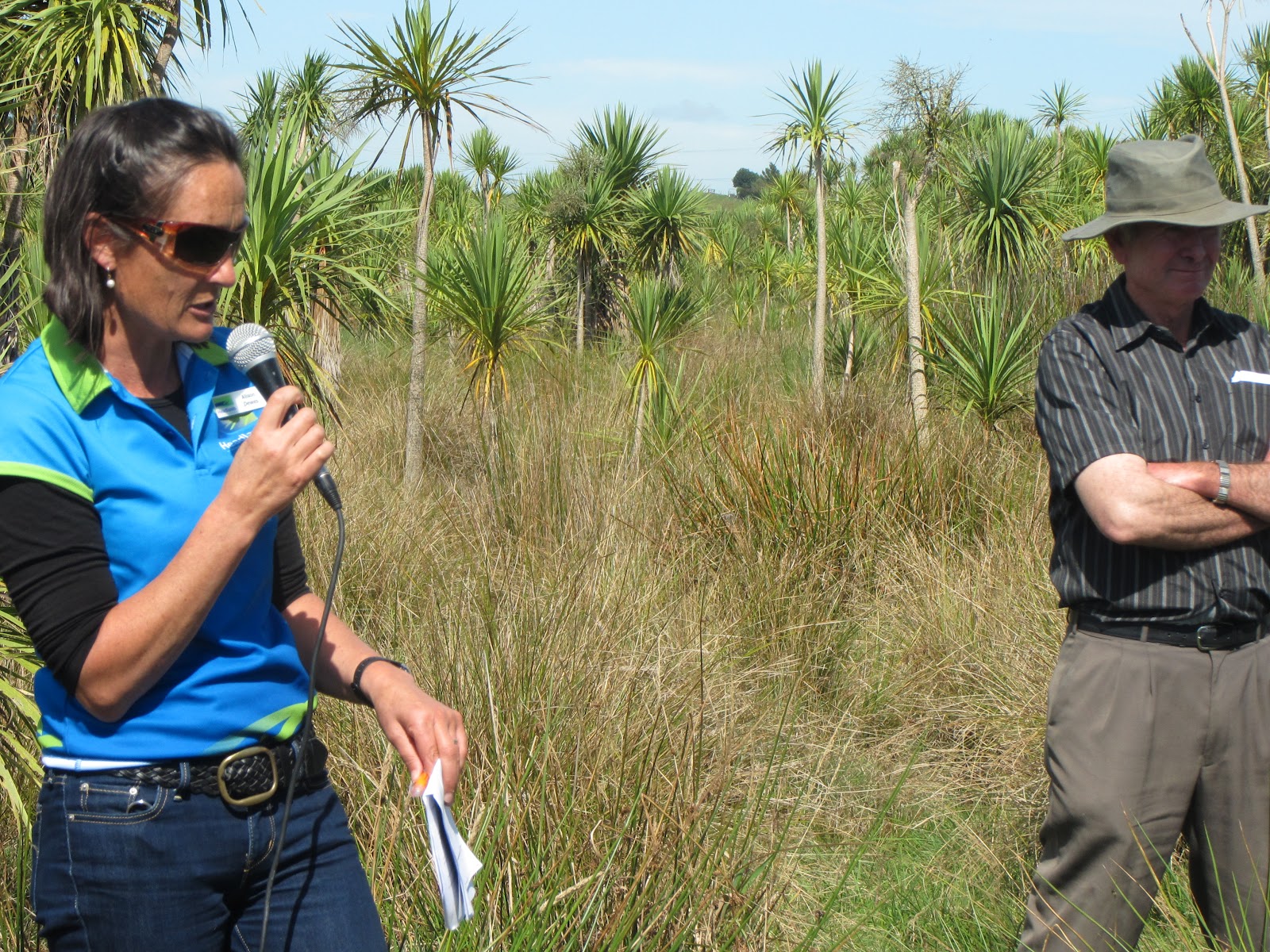
Andrew, Jenny & Fred Hayes are NZ Landcare Trust Ambassadors. In 2005 they won the BFEA- Heritage Restoration Award on their dairy farm for their work around Lake Kaituna & Lake Komakorau. Lakeland Farms surround both of these Waikato peat lakes. Dairy Consultant Alison Dewes (Headlands) told the Waikato Balance Farm Environment Award Alumni Field day that the Hayes family farm system is strongly aligned to their values & beliefs to improve the environment in which they farm. They are aware of what impacts their farm has on the wider environment & they are open to new ideas & ways of thinking. Andrew & Jenny like to measure, assess & review their performance on a regular basis. They have formed a Lake Care Group & invited in many outside experts such as University of Waikato (Prof David Hamilton), water quality PhD student Bex Eivers, Environment Waikato & DairyNZ to help them improve & restore their peat lakes. Involving a wide range of outside people & other local farmers has brought together scientific & regional expertise & practical common sense.
I was particularly impressed with the work experienced Dairy Consultant Alison Dewes (Headlands), has brought to the farm. 
  http://www.headlandsenviro.co.nz   
 Her work suggests that moderate stocking rates, close monitoring of inputs & costs can generate more profit when there is an environmental “push” & focus by the farmers. This is a seriously important message as many farmers believe that complying with environmental standards will in some way reduce their profitability. The Hayes farm is a shining example that their passion for a better lake environmental outcome has in fact improved many of their key production efficiencies & increased their profits. This year they expect to harvest 14.5 TDM/ha of pasture (which puts them in the top 5% of Waikato dairy farmers). The profit per ha is very high & means their Return on Assets (ROA) is over 9%. Over the last 8 years they have reduced nitrogen use from 180kgsN to 30kgsN/ha/yr. Nutrients are much better utilised & recycled with 90% of the farm is covered with farm effluent once a year & no fertilizer is brought onto the farm. So it can be done & the Hayes family are a very good example to all dairy farmers in NZ.
Prof David Hamilton explained to the field day that the Waikato Peat Lakes were formed 15-18,000yrs ago & are today biodiversity hotspots that have important functions of moderating extreme flood events & reducing nutrient flows into the river systems. The health of the lakes reflects the health of the landscapes. Relatively low cost on farm changes are considerably more affordable that major lower catchment mitigation which is prohibitively expensive. There are 94,000ha of peat soils in the Waikato with 80% developed into agriculture & horticulture. Developed peat soils are highly productive soils but there is a risk of them being over drained & lost to farming.
Andrew Hayes created a 16ha buffer zone around the peat lakes, which were badly silted & completely retired a further 2ha of land. Willows were removed & more suitable species planted in the buffer zone. On the 10 inflow drains silt traps were constructed. Bex Eivers PhD study is looking at the effectiveness of the silt traps. The work around the lake & the more water that is being retained in the lake has had a positive impact on the farm as the retention of moisture has helped to minimise the peat shrinkage & Andrew doesn’t have to cultivate the peat soils. A flatter milk production curve has resulted from more summer pasture growth. Andrew quite rightly credits what is happening in the soil & water as being vitally important & Consultant Alison Dewes (a key team member) focusses on pasture grazing management, profit & cost control. 
There is a saying "that YOU (farmers) can’t be GREEN if you are in the RED." Very true! However it is also a truth to say "that if YOU (farmers) want to be in the BLACK you must also be GREEN."

Friday, 11 November 2011

Regenerative Agriculture & Holistic Grazing Management


What has Regenerative Agriculture got to do with UK pasture based dairy farmers?
I think regenerative agricultural technologies have a lot to offer experienced pasture farmers who understand grazing management principles. I liken it to the best chefs who after having a classical training can go on and create the most amazing dishes. The same with classically trained singers & musicians, once they have mastered their craft they can go on to produce the most imaginative & creative music. So it is with grazing, soil, & water management….first you master the classical training then you use those skills to be creative. In this case it is to create topsoil & to control water & water flows on your farm. 
Regenerative agriculture is an opportunity to move beyond sustainability to become regenerative & to rebuild the biological capital on your farm. During the industrial agricultural revolution food production yields have raised, efficiency of yields has improved but at what cost to the environment & soil in particular soil carbon. Holistic grazing involves mixed pastures with many deep rooting species being grazed at much higher pasture covers. The concept is to feed both the cattle & the soil. 
So Who Are the Movers & Shakers?
In this new approach several American names stand out as leaders….Allan Savory, http://en.wikipedia.org/wiki/Allan_Savory
 http://www.holisticmanagement.org/    Gary Zimmer, Abe Collins & ofcourse the very well known Joel Salatin. http://www.polyfacefarms.com/
Many YouTube clips give a very good idea of how Joel Salatin’s grazing operates & how he thinks.
Joel has become a writer of many best selling books with intriguing titles like “The Sheer Ecstasy of being a Lunatic Farmer”. How could you resist a book like that?

However its not really that new…..nothing is, is it? And it’s closer than I ever imagined. A Pasture to Profit Discussion group member on the Cotswolds is a direct descendant of the Scottish landowner Robert H Elliot, 1898, who created & wrote about his system of farming that involved laying down land to grass, using deep rooting pasture species & grazing cattle to rebuild the topsoil, to better use water & to increase the biodiversity.
http://en.wikipedia.org/wiki/Robert_Henry_Elliot    Robert H Elliot’s book “The Clifton Park System of Farming” sets out his key principles.
In Australia, P A Yeomans during the 1930s developed a system of on farm water flow management & regeneration way before his time with a concept called “Keyline management” http://en.wikipedia.org/wiki/P._A._Yeomans
Keyline systems are designed to move water about a farm landscape to get the maximum about of pasture growth. It’s an incredibly clever concept that is amazingly simply but highly effective. The key objective is to control water flow across your farm. The core essence is to enhance the agricultural landscape with trees & pasture being grazed by cattle.
What is central to all of the above agricultural innovators & their systems for enhancing the environment & rebuilding topsoil is that the grazing of pasture with cattle. Many current day environmentalists/climate warming spokespersons quite wrongly think cows & cattle are a problem to the environment NOT the solution.
This is fascinating stuff & quite challenging to much of what is practiced on low input pasture farms…..that’s why you are the most qualified to take up & implement either all of or most of the principles of holistic grazing management. If you are a non believer that’s fine “I’ve never learnt anything from someone who always agrees with me”.
If I have reservations myself it relates to how this thinking can be exploited in high rainfall areas……..as it is being most successful in dry or even arid environments. The principles are however very important & universal. Several P2P group members are already experimenting & as with all pioneers (they are the guys with arrows in their backs in case you dont know how to spot them!)  it's not plane sailing but at least they are "having a go Mate!" which is fantastic for all of us. We need to focus on increasing soil carbon.
RegenAG are running courses in the UK with Darren Doherty from Australia & during 2012 there will be holistic grazing management workshops & Joel Salatin is coming over to run a 2 day workshop in either Nov or Dec 2012. You will need to register your interest now for that course.
This will be my last UK based blog for three years as I’m returning to NZ to take up a University post with the new “Centre of Excellence in Farm Business Management ” at Massey University. So the next blog will come from Palmerston North, NZ.
Current UK Pasture Measurements
TheAverage Pasture Cover (kgsDM/ha) & Pasture Growth (kgsDM/ha/day)
North Wales, AFC 2111, growth 20 still VG grazing conditions
Shropshire, 1850, growth 30, cover increasing
Shropshire, 2000, 45 day round, 40% dried off
Herefordshire, 2150, gr 18, de 20, soil temps 12, Now OAD pulling plug on 22nd Nov.
Herefordshire, 2219, gr 22, de 16, cows in by night, grazed 65% of farm since 1st Oct.
Dorset, AFC 2003, growth 20
Devon, AFC 2400, growth 30
East Sussex Cows in, pasture still growing in mild temps, Could be a good early turnout Jan/Feb in South East.
Cornwall, AFC 2480, gr 36, de 39, Awesome year!!!
Northern Germany, AFC 1925, growth 7, last 10 days grazing its been a very decent year!
My thoughts are with our friends in the Breton Group in France as Odile is going thru a rough patch. Our best wishes are with Alain & Odile, who are amazing people & wonderful friends!

Friday, 12 August 2011

You Too!...... Should Be a Nuffield Scholar

How “People Sustainable is your Farm Business”?

One very important component of a Sustainable pasture based dairy farm is how sustainable is it for the people within the farm business? I want to look at a number of different aspects of this question related to people sustainability within a dairy farm business & how you might manage this better in your business.
The first aspect I want to consider is the ongoing self education & training required by the owners & key players of the business. Most full time farmers have limited opportunities for organised or formal tertiary training, although there are some courses out there that are very useful. Most of the adult learning & business training that happens on farms has to be “self directed learning”. You organise it. You manage it yourself. This shouldn’t come as a surprise nor should it concern anyone within the “Pasture to Profit” network of pasture based dairy farmers in the UK & France. After all the farm Discussion Groups are self organised to meet self directed learning needs.
However the groups effective as they are (if they are well run using well trained professional facilitators….I’m horrified to hear that some groups that have tried going it alone are crashing), it’s only the beginning of what needs to be ongoing self learning. If you don’t & if not enough British & French farmers get off the farm & go to see what is happening overseas we will rapidly get isolated & left behind.
Have you considered a Nuffield Scholarship?
Within the Pasture to Profit network there are about 30 current or recent Nuffields (including several from NZ & Australia). Nuffield scholarships provide a fantastic opportunity to “get away” from the farm, to travel & to study an area of personal interest. Nuffield is open for business as applications for 2012 close on the 15th November 2011. Nuffield needs farmers with passion & drive, both men & women (Fiona Hillman was a very successful Nuffield from the Wyegraze DG) Nuffield is also available in France. Apply now online......
http://www.nuffieldscholar.org/index.php
Most Nuffield Scholars describe it as a life changing experience. Often the farm business changes significantly & people look at new opportunities. When you get away you have a unique opportunity to look back at your business like you’ve never done before.
One very important aspect of doing a Nuffield is the life long networking with passionate effective farmers from all round the world. We are very fortunate to have so many recent Nuffields in our network. Here is an opportunity to talk to them about Nuffield either on the phone or Facebook. There are 25 Nuffields in the online Facebook group.
Recent Nuffield Scholars
Tim Downes, Shropshire
Tim Wall, Devon.
Roly Tavernor, Shropshire
Will Edwards, Monmouthshire
Fiona Hillman, Monmouthshire,
Robert Richmond, Gloucestershire (currently travelling in Australia)
This week I met John Stones up in North Wales. I explained how I viewed the importance of Nuffield to the pasture based dairy farmers. Firstly it’s really important to the ongoing development of our best people. Secondly, we as a group have virtually no research being conducted in the UK for our sector. The returning Nuffield scholars bring back the latest information & research implications & how the new information might be applied on farm here. Thirdly, they challenge the Discussion Groups thinking with the new ideas. Lastly it extends & enhances our network worldwide.
Another travel scholarship available to UK farmers is the Churchill Travel Fellowships. http://www.wcmt.org.uk/  
These Fellowships have no upper age limit but are only available for 4-8 weeks of travelling study. Applications for 2012 close on the 4th October 2011.
Many county shows also offer travel awards mainly for young farmers & ofcourse YFC encourage overseas travel & exchange.
All good Discussion Groups in the UK need to travel overseas much more than in the past & to many more countries.
You have to be in to win. Talk to recent scholars about their experiences & we’ll back you. I will give you as much help as you need & plenty of needle to apply too.
Pasture Growth Update.
Current Pasture Covers & Growth Rates this week.
South Ayrshire, Scotland, AFC 2300kgs DM/ha, Pasture Growth 53kgsDM/ha/day
Dumfries, Scotland, 2190, growth 90, demand 37.
North Wales, 2178, growth 58, demand 56 excellent rain (Tom got soaked this week)
Hereford organic, 2154, gr34, de38, 2nd week of slow growth
Gloucestershire, 2100, gr 38, cover now 200kgs behind budget.
Oxfordshire, 2000, gr 25, had 25mm rain but growth slow to respond
Dorset Organic, 2605, gr 54, fields vary from 24 to 100kgs growth
Dorset, 2455, gr 64, demand 40, clover VG this year
East Sussex, 2010, gr 20, grazing 4500kgs stored grass with dries "Life is Good"...obviously watching cricket this week!
Pembrokeshire, SW Wales, 2344, gr 72, de 63 good rain expect good result Saturday at Cardiff
South Kilkenny, Ireland, AFC 2146, growth 54, demand 51, 25 day rotation

Rhys Williams, North Wales a Nuffield last year with visiting group

Saturday, 6 August 2011

Caring Pasture Based Dairy Farmers Encourage Biodiversity

Biodiversity on pasture based dairy farms is seriously important. If dairyfarmers are seen by the public to be caring for the environment & making a special effort to protect the biodiversity, this too is a major PR with our consumers. There are very strong arguments for farmers to protect biodiversity as well as enjoying it for its own sake. The farms are both our homes & our work places.

Ben & Jerry the ice cream makers have established the “Caring Dairy” Program with Sustainable Indicators. Most pasture based dairyfarmers would embrace this program & agree fully with the targets.
Sustainability Indicators: measuring sustainability performance
“Caring Dairy” has developed 11 sustainability indicators. For each indicator, measurement points or parameters have been defined that enable actual performance measurement. Each Caring Dairy farmer determines the focus of his improvement plan based on the farm situation – such as soil type, land division situation, farm strategy – and personal priorities. http://www.benjerry.co.uk/caringdairy/11indicators.php  
 Biodiversity
Agriculture has shaped most ecosystems in the world, and biodiversity can be improved or reduced by agricultural practices. Some biodiversity is highly beneficial for agriculture. Sustainable practices can improve biodiversity - by `greening the edges' of the field.
Examples of parameters:
1) Level of biodiversity on site: number of species (e.g., birds, butterflies) and varieties (e.g. grass); farm landscape; habitat for natural predator systems (e.g., hedgerows, ponds, non-cropped areas)
2) Level of biodiversity off-site: cross-boundary effects.
Apart from its intrinsic value, biodiversity has a function in a number of ecological processes highly relevant for food production. These `life support functions' of biodiversity include the soil nutrient cycles & regulation of pests by means of biological control. Agrotechnology has broadly increased the independence of these functions at the cost of high inputs of fossil fuel, artificial fertilisers and pesticides. The concept of `sustainable' agriculture aims to re-establish equilibrium: life support functions and technology should be farm attributes of equal importance. Here, the integration of farming and nature comes into play.
Australian studies in Gippsland, Victoria have shown that: - Sheltered pastures lose 12 mm of water less than open pastures during the spring growing season. Sheltered areas have increases up to 17% (estimated) in dairy milk production and 20% (estimated) in average annual pasture growth for meat producers.
http://www.dpi.vic.gov.au/dpi/vro/wgregn.nsf/pages/wg_lwm_biodiversity_farms
As well as having a high-tech context, pasture based dairy farming needs to embrace a keen understanding and use of ecological patterns and processes and a tolerant attitude towards nature elements on the farm: managing biodiversity is the starting point for ecologising agriculture. The dairy farm at Wageningen University in The Netherlands has been a leader in this field of dairying being a holistic approach. http://www.carmelacanzonieri.com/6321/readings/agriculture/Smediing-landsc%20ecol%20farm%20planning.pdf
Sustainable dairy farming is protecting and improving the natural environment, animal welfare, and conditions of the local communities, while at the same time being productive and efficient.
http://ageconsearch.umn.edu/bitstream/24234/1/cp05va03.pdf
• Producing milk with a high nutritional quality to meet existing and future needs, while keeping resource inputs as low as possible.
• Ensuring that any adverse effects on soil fertility, water and air quality, landscape and
biodiversity from dairy farming activities are minimised and positive contributions are made
where possible.
• Optimising the use of renewable resources while minimising the use of non-renewable
resources.
• Sustainable dairy farming should enable local communities to protect and improve
their well-being and environments.
• Sustainable dairy farming should ensure an optimal well-being of the animals (cows).
Profitable pasture based dairyfarmers need to show the world that they care for their environment & that they want to encourage biodiversity.
Unprofitable dairyfarmers are not in that position. Quote:- "If you are in the Red its very hard to be Green"
Current UK Pasture Measurements
Pasture growth still very variable dependant on rain. You have either had it or still waiting for it!
TheAverage Pasture Cover (kgsDM/ha) & Pasture Growth (kgsDM/ha/day)
Scotland, South Ayrshire, Average Farm Cover 2420, Pasture growth rates this week 91kgsDM/ha/day
North Wales, 2220, gr 70.
North Wales, 2070, gr 70, just enough rain at right time
Cheshire org, 2000, gr 25, 42 day rotation, no rain, feeding silage & cake
Staffordshire, 2220, gr 10
Staffordshire, 2100, gr25 burning up fast need lots of rain
East Staffordshire, 2000, zero growth NO RAIN
Shropshire, AFC 1947, growth 15
Derbyshire, 2157, gr16 feeding cake & wholecrop, 5mm rain
Nottingham, 1800, zero growth, demand 69, going backwards soils very dry
Herefordshire org, 2000, gr 20 very dry missing rain
Herefordshire org, 2213, gr 37 demand 33, getting dry
Herefordshire org, 2090, gr39 demand 40
Gloucestershire, gr 42 down 25kgs on week very dry until 16mm rain
Oxfordshire, 2100, gr 29, de 25 15mm rain expecting lift in growth
Somerset org, 2470, growth 51 great growth plenty of rain
Dorset, 2000, gr 30, plenty of rain yesterday
SW Wales, 2170, growth 75
East Sussex, 2100, gr 30, cows dry, 25mm rain yesterday
Cornwall, 2610, gr58, taking silage out to lower AFC 2450
Northern Germany organic, AFC 2130, growth 49, 23 day rotation Wet & Warm!

Friday, 15 July 2011

Bee Roads & Wild Flowers can help save the bees in the UK...Pasture Farmers are Key Players

Do you know what a “Bee Road” is? It’s a wild flower planting on farms to attract & protect Bees. I’ve started my own “Bee Road” sowing a wild flower strip of about 40metres x 10m along a roadside on a pasture based dairy farm.  https://www.cotswoldseeds.com/seedmix/wild-flowers-1  It was sown this spring & is now in glorious techno colour. The bees & insects love it but there have been some problems like the dry weather & weed infestation. I am justly proud of my efforts but there are frustrations.
I’m however really angry at the moment East Staffordshire Council has just mown part of the roadside where I planted some of my roadside wild flowers or “Bee Road”. Of course the ability of those flowers to seed has been lost due to the vandalism of the council who have a May & June mowing routine. The roadside mowing routine shows that local authorities have no understanding, nor any real commitment to protecting the English biodiversity & specifically the humble but incredible important honey bees. http://www.telegraph.co.uk/finance/comment/ambroseevans_pritchard/8306970/Einstein-was-right-honey-bee-collapse-threatens-global-food-security.html 
Almost a third of global farm output depends on animal pollination, largely by honey bees. These foods provide 35pc of our calories, most of our minerals, vitamins, and anti-oxidants, and the foundations of gastronomy. Yet the bees are dying – or being killed – at a disturbing pace.
Bees are incredibly important to agriculture including pasture based dairy farms. Yet as I walk pastures day after day in the UK I see virtually no Honey bees & relatively few Bumble bees. Honestly when did you last see Honey Bees on your pastures?
I can proudly say that pasture based dairy farmers in the UK do have pastures that contain a lot of white clover, some red clover & some herbs like Chicory which all feed the bee population. Excessive use of Nitrogen fertilizer creates a monoculture of ryegrass with no flowering species for the Honey Bees. Grass based milk producers depend on the pollinators to reseed pastures with lush clover. Thats why grass fed milk is so much healthier.
http://www.liberation.fr/terre/0101614579-des-fleurs-le-long-des-routes-pour-sauver-les-abeilles
In France, Dominque Bussereau, Secretary of State for Transport announced in January 2011 an ambitious plan to plant 250km of roadside in France with wild flowers to attract & protect the bees. This is likely to be extended over much of France with perhaps 12,000km of roadside being planted to help the Honey Bees. What an amazing plan!
"The Cooperative" Supermarket Group in the UK has taken a number of initiatives to save bees to the UK. This includes donating £750,000 for “Bee Roads”…wild flower plantings on roadsides in the UK. Good positive assistance by a supermarket retailer.
http://www.co-operative.coop/corporate/ethicsinaction/takeaction/planbee/ways-to-get-involved/help-pollinators-in-your-garden/
http://www.co-operative.coop/corporate/ethicsinaction/takeaction/planbee/news/bee-roads/
The Telegraph newspaper is to be congratulated on its “Save the Bees” campaign.
http://www.telegraph.co.uk/earth/countryside/8455754/Wild-flower-planting-will-boost-bumblebee-numbers.html
The evidence is that sadly the biodiversity in the English countryside is not what it used to be…. & this is affecting the bee population on which agriculture & food production is so reliant. You only need to look at the roadside hedges in the English countryside…they are lovely & green but often without flowers…especially if the Council has mown it. (Why don’t they put their efforts & man power into fixing the pot holes instead of vandalising the bee habitats with a tractor mower?)
See briefings 1295 about the National Ecosystems Assessment for the UK.
http://www.arthurrankcentre.org.uk/publications_and_resources/rusource_briefings/
Pasture based Dairy farmers need to take a public stand & be vocal about their support for saving the bees & for increasing the biodiversity on farms. We are already leading the way but we need to speak up & be heard. We have plenty of opportunities to plant either roadside “Bee Roads”, keep bee hives on the farms or help stop local authority vandals from mowing the wild flowers when it is totally unnecessary.
Join my campaign to stop the Local Authority vandals & to plant your own wild flower Bee Road to help save the Honey Bees in the UK.
Current UK Pasture Measurements Pasture growth still very variable dependant on rain. Excellent summer growth in some areas but very little growth in the drier counties of Derbyshire, East Staffordshire & Oxfordshire.
TheAverage Pasture Cover (kgsDM/ha) & Pasture Growth (kgsDM/ha/day)
Scotland, South Ayrshire, AFC 2154, Pasture growth this week 100 kgsDM/ha/day
Shropshire, 2475, growth 46, cumulative YTD 5177kgsDM/ha same as last year.
East Staffordshire, 2100, gr 28, dem 35 little or no growth very dry
Derbyshire, 2142, gr 20, dem 59, V Dry, 2leaf PRG 40% DM of paddocks
Nottingham, gr 28, demand 59, 30 day round feeding maize
Oxfordshire, 1950, gr 15, dem 30 still V dry, topping was a bad idea
Gloucestershire, 2135, gr 66
Herefordshire, AFC 2100, growth 70, Demand 60
Pembrokeshire, AFC 2216, gr 74, steady growth for last 3 weeks
Dorset, 2500, gr43, dem 45 grazing chicory & Plantain milk yields up but MFat % down
East Sussex 2400, gr 85, cows all dry Holiday Time!!
Northern Germany organic, 2110, gr 65, growth increased after recent rain, 23 day round, 16 hr milkings Going really well!