I’ve
discovered Moumahaki Experimental Farm est.(1892) in South Taranaki, New Zealand.
A
fascinating story of how Research & Demonstration Farms started in New Zealand. It’s
what happens when you are left alone and get lost in a book shop! A weekend
discovery gem!

This is part of my history.
I’ve worked as an Agricultural Scientist in Extension and
Dairy Farm Consultancy with farmers in NZ, Australia, Taiwan, UK, Ireland and
France visiting research and demonstration farms, all my working life.
For 33
years the Experimental Farm at Moumahaki was a jewel in the crown of the
farming industry. Today we debate the merits, funding and roles of these farms
just as they did in the 1890s.
These farms need to take risks, set big targets
and go far beyond the practices of the day. They will be criticised and
lambasted by non-believers, the unconvinced and the funders.
Through challenging
the thinking of the day, ignoring the boundaries, imagining the future and good
science they progress agriculture forward. Moumahaki really did it in the most extraordinary manner.
Over
2000 farmers visited the Moumahaki Experimental Farm each year to view the
research & farm systems being tried on the state run property. Most
travelled by train.
Today there is little evidence left of this historic site. (See photos.)
Today there is little evidence left of this historic site. (See photos.)

They
arrived at the Moumahaki Railhead, were picked up by the farm staff, given
dinner then walked over the farm listening to the manager explaining the research results.
Groups of up to 200
arrived by train. Some like the Feilding A & P farmers came annually to
visit & learn. Dairy Farm Discussion Groups still travel together to learn together.....perhaps not by train so much today!
The
farm had four distinct purposes- demonstration, experimental, scientific and
educational according to Laraine Sole’s book “Moumahaki Experimental farm”.
The
initial 300 acres (120ha) consisted of poor pasture and bush, some good flats
& some very steep sidings with a river frontage. The first Manager was
Francis Gillanders from Scotland.
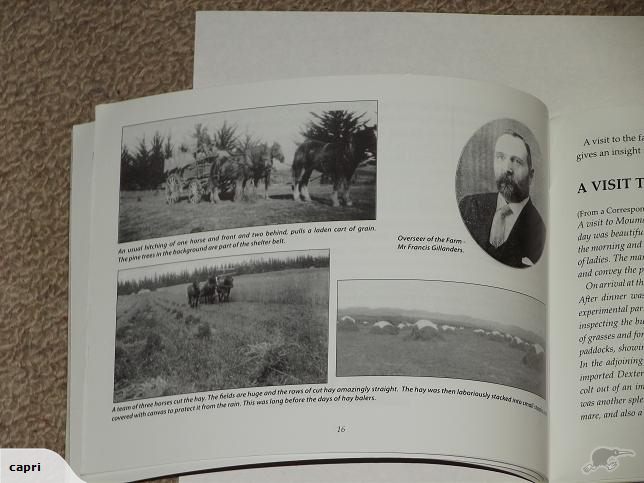
Mr
Francis Gillanders set about to establish an experimental farm that included dairy cows
(Ayrshires), beef, sheep, pigs, poultry, potatoes, arable, vegetables, fruit
(apples, pears, grapes & even pineapples). Early experiments included
pasture establishment, hedgerows and the use of different fertilizers at
varying rates. Breeding trials (with imported selected livestock) were
conducted with Kerry Dexter cross cattle, Shire and Clydesdale horses, Ryland
sheep, Strawberries, Mangolds, Swedes and Kale varieties.
Mr Gillanders is quoted as saying
" The public have a right to criticise, and it is only to be expected that they will do so; but with all due respect to some of the critics, they might get a little more authentic information on the subject before attacking what they evidently know next to nothing about".
Agricultural research funding & extension was obviously alive and well even back then in the 1890s. I'm starting to like this guy!

Moumahaki
Experimental Farm was the very first in NZ. Few farmers or advisors have heard
about this remarkable farm. Located in South Taranaki, north of Waitotara, in New
Zealand it was the first State Experimental Farm established by the new NZ
Department of Agriculture in 1892.

There
was an “Agricultural & Pastoral Conference” at Christchurch in 1892
attended by A & P Show representatives from all over NZ.
They moved “that in the opinion of this conference the establishment of a properly equipped expert agricultural department is urgently required in NZ. That although there was a Department of Agriculture there was no official in a responsible position who could give advice and assistance to settlers” A petition was sent to Parliament demanding action.
They moved “that in the opinion of this conference the establishment of a properly equipped expert agricultural department is urgently required in NZ. That although there was a Department of Agriculture there was no official in a responsible position who could give advice and assistance to settlers” A petition was sent to Parliament demanding action.
From
the early 1870s there was considerable discussion, in newspapers and elsewhere,
about the necessity of scientific and technical education for farmers. There
were numerous commissions, reports and intense debates about how to establish a
formal system of agricultural education. Lincoln Agricultural College was
established in 1880 and Massey Agricultural College in 1926.
The
1892 A&P conference had recommended that the department provide farmers
with scientific information. The departmental response was to establish
experimental farms (one (Moumahaki Experimental Farm) near Waverley in Taranaki
and one at Waerenga (Te Kauwhata) in the Waikato in the 90s and 7 more by 1910
including Ruakura (1901)).
The
state of thinking at this time is reflected in the Governor’s speech on the
opening of Parliament in August 1906, "My advisors deem it advisable to
encourage the application of scientific methods to productive processes in
order that our farmers may successfully meet the increasing competition from
other countries. Though much has been accomplished in this direction, much yet
remains to be done" (Parliamentary Debates 1906).
So
began Agricultural Extension and Experimental Farms for research and demonstration
in New Zealand.