Showing posts with label Farm trees. Show all posts

Saturday, 24 August 2013

Farm Tree Planting Together is FUN


Planting Farm Trees.

Planting farm trees is best when you plant with community friends. I had a great day tree planting in a wetland area on farm with 30 new friends. It was really fun! So much fun that I will continue to invite the community rather than using contractors.

The environment and protecting the quality of our rivers & streams is a community responsibility. Farms need to engage their local communities in helping to plant trees,  Trees that are aesthetically beautiful, trees that are ECO-Sourced, trees for bees, trees that reduce N leaching.

What few farmers appreciate is that the community want to help, they enjoy planting trees, they enjoy planting trees with their children and they like having fun together. Isnt that great….a community having fun together! WOW!
We invited members of our community to come & help plant trees. Horizons the local Regional Council has been involved from the start & have been very helpful to get ECO-Sourced trees from the local region & trees at a reasonable price. 
We invited Massey University Young Farmers to join us as a fund raiser.........it was exciting having all ages working together for the good of the community & the environment.

We plan to plant a total of 20 hectares (17%) in trees out of a total 120 hectares. Some of you might think that is a very big percentage of a pasture based dairy farm? We are planting areas near waterways, riparian planting along rivers & streams. Also due to Nitrate leaching risks we are changing the land use (away from grazing to trees & cropping) based on a NZ system of land classification.

25% of farm area into habitat planting in UK
There is an opportunity here to move away from selling commodities and to add value before the milk leaves the farm. Tracing the product's provenance from farm to fridge needs to be talked about much more in NZ. Factors such as Biodiversity, wildlife, water quality are attributes that could add value to dairy products that are sold in China, India & the EU. There are schemes such as LEAF in the UK and ECO-PLAN (Marks & Spencers in UK) where animals must graze pasture. Farmers in the Netherlands are paid premiums if their dairy cows graze pasture.
Waitrose, UK supermarkets & Dairy Crest (Milk Processors) have introduced a scheme to reward dairy farmers who plant trees on 25% of their farms.

This independently monitored scheme measures habitat levels and species numbers, as well as providing expert advice on enhancing wildlife habitat. The results achieved have been exceptional with the average level of habitat over 25% of the total farm area. There have also been many successful species improvements. Waitrose Wildcare Program  

 The aim is to encourage farms to operate more efficiently whilst addressing consumer requirements for quality and sustainability. The standards will require that suppliers undertake a regular carbon footprint of their dairy operation. They also expect farms to recognise their role as custodians, and consider potential opportunities to enhance the countryside (e.g. via the planting of trees, hedgerows, management of water resources and/or direct engagement with environmental stewardship schemes).

There are some excellent NZ dairy farmers making a real effort to protect the waterways by planting trees.

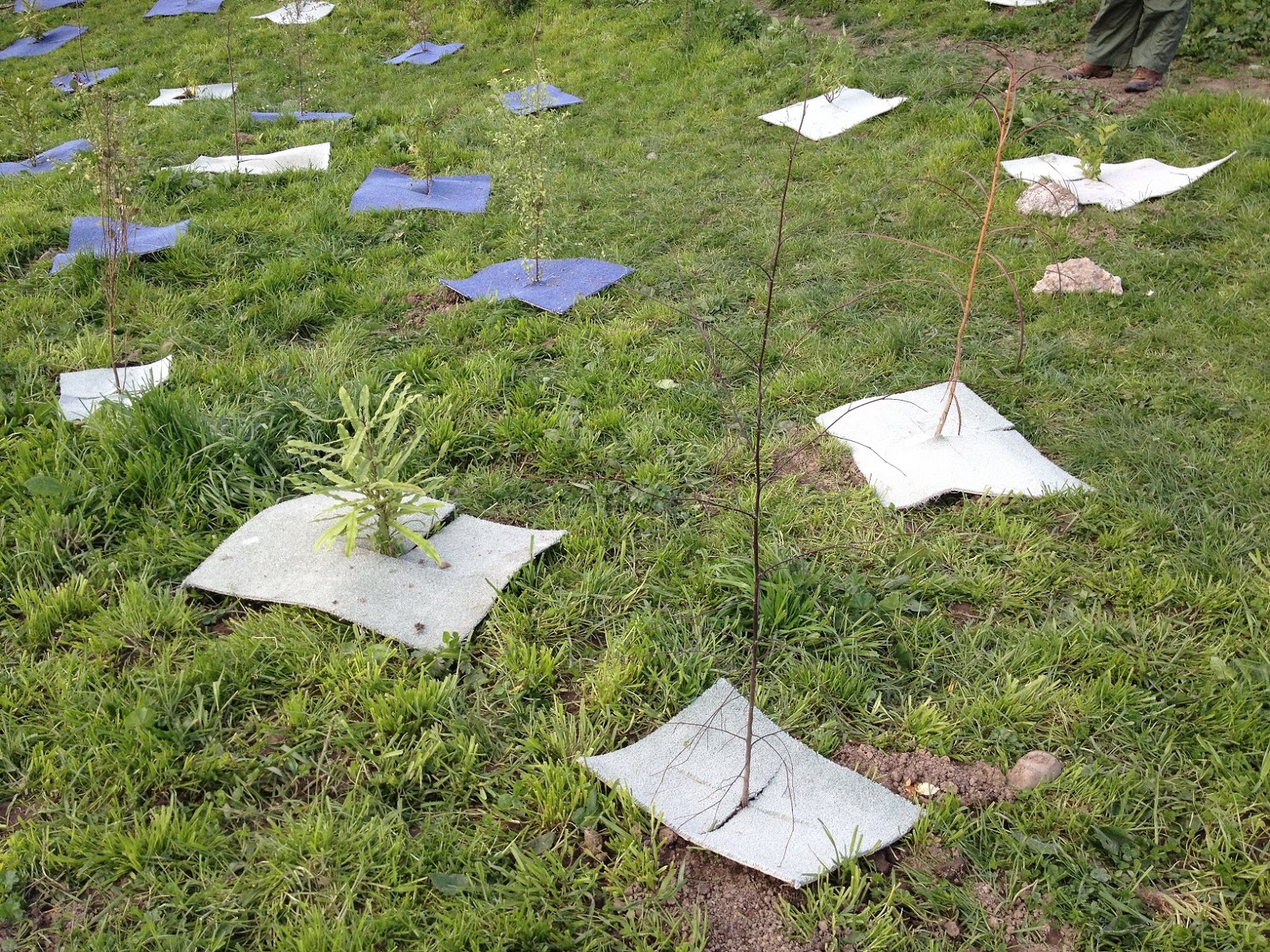
Old Carpet for weed control

It is important to protect young trees when you are planting on farms. We used old carpet...a local company would have paid to dump this waste material.....we got it delivered to the farm. Hopefully carpet  waste materials will retain moisture & reduce weeds & the need for chemicals.
What do you think?

Tuesday, 25 September 2012

New Zealand Dairy Farms Have So Few Trees. Why?

I want to encourage more trees on dairy farms, including perhaps Cider Apple trees.

 Mixed Tree Species on farms can add to the environmental biodiversity. Imaginative shelter belts create a better work place. Trees add to the aesthetics of the farm. Effective tree shelter belts are good for animal welfare and may increase pasture growth. Could Cider Apple Trees also create another income for dairy farmers?

So why do New Zealand dairy farms have so few trees?


NZ dairy farms dominate the NZ landscape. Too few farmers regularly plant trees on their farms. Too few farmers appreciate how diverse tree planting might add to the sustainable output of the farm. Too many dairy farms have cut out the existing trees. The NZ rural landscape has too few trees.
This wasn't always the case. The black & white photo at the top of this blog is of my grandfather J A Cooksley harvesting home grown pears off his dairy farm at Opiki in the 1930's.

 One of my French farmer friends Yvon (who is himself a very keen farm tree grower) suggests that "Our generation (of dairy farmers) have forgotten how to grow trees"

Do dairy farmers today understand how to grow trees? Every time I visit Europe I’m intrigued by what pasture based dairy farmers are doing to improve their environment & sustainability of their farm business. Farm trees are an essential part of a rural landscape. Trees make a rural farming landscape beautiful. Trees help link the city people to the country and to farmers. More trees on farms would in my view help unite city/farmer thinking about the environment.


In France I saw pasture based dairy farmers planting apple trees on their farms. The apple trees were often Cider tree varieties. Sometimes these Cider trees were planted in small blocks and the apples/pears harvested either for sale to a local Cider maker or bottled into Cider for home consumption. These farms often had bee hives and the apple blossom helped to feed the bees when few other flowers were out. A healthy bee population is of critical importance to agriculture.


French farmers in Brittany (a pasture based dairying area) included apple trees in the tree belts partly for the bees and partly for the sheer joy of being able to eat fresh home grown apples. Every tenth tree in a tree row or talus (French raised soil mound for tree planting on farms) could be a fruit tree. The planted talus--a steep earth berm (an earthen mound often between a road/track & a drain), planted with beeches, oaks, or hornbeam--was traditionally created to delimit the boundaries of farms in both Brittany & Normandy.

Learn about Bretton farmers tree planting

Most New Zealand farmers probably think we live in a country with a lot of trees. Is that really correct? In Europe there are a lot more trees on farms. In Australia most farmers belong to Landcare Australia.

Aussie farmers have planted thousands of trees to help protect and improve the farm environment.
Sadly most NZ dairy farms are stark & bare without many trees. NZ farm tree belts tend to be monoculture species. Have we lost the tree planting skills & the understanding of how trees might contribute positively to a healthy farm environment?
 NZ Landcare Trust can help you learn about trees on farms

Farms can be great places to bring up children. Farmers often forget that they are so lucky to live and work in the country.
I challenge all farmers…..is there a “Magic Spot” on your farm which makes you feel great just sitting, reflecting and thinking? Is it the trees near your favourite place on the farm that makes it really special for you & your family?
If you have no idea what I’m talking about, you urgently need to start a tree planting program for your farm.

Saturday, 23 July 2011

Cidre Trees, Windbreaks & Landcare. We Need to Get Involved & Rethink

I don't think UK farmers are planting enough new trees on their farms. On a recent UK “Pasture to Profit” discussion group study tour of Brittany with a group of pasture based dairy farmers I could help but be impressed with the relatively new Tree rows or farm hedges that some of the pasture based dairy farmers in Brittany were planting. They are quite different from what is commonly seen on English farms. The hedges consist of a number of different trees but also included both flowering scrubs & even fruit trees. These new & very attractive farm hedges/windbreaks were taller & more open than most hedges in the UK.
They were more effective windbreaks, less annual work to manage & aesthetically very attractive.

Do we have enough trees on our UK pasture based dairy farms? Are our hedges very effective? Is there an opportunity here to add to the biodiversity on our farms?
The answer I think is NO, NO & YES.
I’m not suggesting the traditional hedges be ripped out as they are an important part of the UK agricultural landscape & this working industrial landscape is hugely important to our heritage & the tourism industry.
However compared to other agricultural nations the present farmers are planting very few new trees. I think this is both a problem & a lost opportunity. Take the Landcare movement in Australia for example. Most Australian farmers belong to their local Landcare group & most Australian farmers are actively planting thousands of trees. We should be doing this here in the UK. Why don’t we start a Landcare UK group in every rural district in the country? Pasture based dairy farmers could lead these groups to make sure they were effective & productive groups.  http://www.landcareonline.com.au/
On of the on farm features in Brittany are the trees & scrubs planted into an earthen wall called a "Talus".
The planted talus--a steep earth berm (an earthen mound often between a road/track & a drain), planted with beeches, oaks, or hornbeam--was traditionally created to delimit the boundaries of farms in both Brittany & Normandy.
http://www.frenchgardening.com/aujardin.html?pid=1213276841541215
That's why, if you drive the country roads of the region, you often find your path "sunken" between two steep berms crowned with magnificent beech trees and flanked with a thick tapestry of ferns, vines, and wildflowers. The durability and beauty of this peculiar landscape feature has prompted me to reflect on its use in the UK as a farm shelter hedge. In many ways it is very similar to the hedge rows of Devon & Cornwall that are built on top of an earth mound between the road/tracks & a drain on the farm side of the hedge. These farm hedges in Devon & Cornwall are not recent structures but have been built generations ago.
The talus consists of a packed earth berm say a 1-1.5metres high, half a metre wide at the top, and with sides sloping at a steep angle of 60 degrees. The top of the talus is planted with closely spaced trees in a single row or--more frequently--in an offset double row. The trees are set on approximately 4-foot centres. I know this may seem like impossibly close spacing, but such close planting is integral to the success of the talus, ensuring that a dense network of roots retains the soil of the berm. And believe me, it works. Many examples of talus hundreds of years old, crowned with magnificent towering beeches, bear testament to the validity of these living architectural farm structures & why there has been a recent surge in their use on dairy farms in Brittany. A new generation of pasture based dairy farmers who are not only very conscious of the beauty of their environment but who are keen to increase the biodiversity of their farms, are leading the charge.
The advantages of a talus are that it alone provides shelter for live stock especially calves, there is very good drainage for the trees & scrubs & the bulk of the talus is top soil so it’s an ideal medium to establish trees & a farm hedge.
Effectiveness of Windbreaks & Hedges.
Windbreaks are designed to break up the wind energy/power to provide a more pleasant environment for pastures & livestock on dairy farms. Historically hedges determined farm & field boundaries but today they provide shelter of a sort to livestock especially young calves & milking cows. Are they very effective at providing shelter….probably NOT. There are two major limitations, firstly height & secondly they tend to be near solid structures (density greater than 80%) so they change the dynamics of the wind but do little to provide shelter. In fact they probably increase the wind speed over and around the hedge.
As wind blows against a windbreak, air pressure builds up on the windward side (the side towards the wind), and large quantities of air move up and over the top or around the ends of the windbreak. Windbreak structure -- height, density, number of rows, species composition, length, orientation, and continuity -- determines the effectiveness of a windbreak in reducing wind speed and altering the microclimate. Windbreak structure -- height, density, number of rows, species composition, length, orientation, and continuity -- determines the effectiveness of a windbreak in reducing wind speed and altering the microclimate. Height is a very important factor in the effectiveness of a windbreak/hedge. On the windward side of a windbreak, wind speed reductions are measurable upwind for a distance of 2 to 5 times the height of the windbreak (2H to 5H). On the leeward side (the side away from the wind), wind speed reductions occur up to 30H downwind of the barrier. However this is influenced by the density. So a density of 40-60% is the most effective at providing downwind area of protection. A density under 20% is ineffective & as already discussed over 80% is a problem. The link between effective windbreaks & pasture growth is well established as it influences temperature. The calves do much better in a well protected environment.
 If you want to read an excellent guide to windbreak effectiveness I suggest you read this article from Penn State University http://extension.psu.edu/plasticulture/production-details/windbreaks  
The more species of trees & scrubs in a hedge/windbreak the better as it influences the height & the density. This allows you to add biodiversity to your farm & include flowering species to help our friends the honey bees. I was impressed in Brittany to see flowering scrubs like Hypericum (the yellow flowering scrub in the photos), Buddleja, Rhododendron, Ferns as well as Heritage apple trees.  Why not add apple trees for example that have flowers & fruit that can be harvested….cider is a very nice drop on a hot day & very traditional.
So our traditional hedges in the UK may not be very effective at either providing shelter, windbreaks or adding greatly to the biodiversity on our pasture based dairy farms. This in my view creates an opportunity & the French examples are excellent. Tree rows with many different species of both local trees & flowering scrubs. There is an opportunity begging to grow more cider apple trees as well.
I think the existing pasture groups should be initiating Landcare groups in their local community & taking a positive lead which could have massive genuine PR value in the rural & city population of the UK.
My thanks to my Breton friends Andre, Alain, Yvon & Jean Herve
Current UK Pasture Measurements
Pasture growth across the UK has generally improved if you have had rain but in the Midlands growth still very slow & soils still very dry. Experience suggests that growth takes sometime to get going after long dry spell but once soils are wet it all happens quickly!
TheAverage Pasture Cover (kgsDM/ha) & Pasture Growth (kgsDM/ha/day)
Northern Ireland, Portaferry, AFC 2150, Growth 78, demand 53, cutting silage bales to improve quality. Lots of showers
Cumbria, 2650, growth 77, demand 50, still silage to cut

North Wales, 1963, gr 64, demand 53,
Cheshire organic, 2100, gr 25, dem 25, round 35 days, feeding to hold covers
Shropshire, 2150, gr 35 but expecting growth after rain this week
Shropshire, 1984, gr 32, dem 33, feeding to build covers
Staffordshire, 2232, growth 35
East Staffordshire, 2100, gr 50 demand 35, light rain but not enough yet
Oxfordshire, 1950, gr 20, rain 15mm so optimistic
Dorset organic, 2550, gr 70, cutting wholecrop today
Cornwall Average Farm Pasture Cover 2450, growth 85, demand 58, more silage not enough cows