Monday, 28 June 2010

Wonderful French Hospitality on Breton Grass based Dairyfarms


"Pasture to Profit" grass based dairy farmers from England, Wales & Northern Ireland again visited Brittany in France & were treated to thought provoking farm visits, wonderful food with local ciders & wines, glorious sunshine & very good craic....banter & fun!
You would be amazed language barriers, doubts or previously held views collapse & vanish over a cold glass of Breton Cider. The Breton friendship & hospitality was wonderful as we met "like minded" farming families, walked the farms, struggled with translation, & laughed together over another cold cider.


The food was amazing!


Tough "Student work"......but someone has to do it!


For some it was exhausting!


Too much really!

I know..what happens on tour stays on tour....but I couldn't resist!
Key Messages from Brittany

Question.... When is your group going to visit Brittany this is a very important tour for every P2P group to make.

Question..... Why are wives not going to Brittany with these group tours???? You are missing out girls!

There is still life after tough NVZs (140kg N/ha organic N) & there is still grass growth in abundance without Nitrogen. Some of the clover swards were fantastic.

Although there are only 50 Organic dairy farms in Brittany (out of 12000) we saw a trend to organic conversion amongst the pasture based dairy farms we visited.

A good reminder from Travarez Research Centre that the average response to concentrates (from many trials) was less than 1 litre of Milk for each 1 kg Conc fed.


Extraordinary that French farmers still have a huge say in the farm research projects.....so different from the UK sadly where UK farmers have lost the effective research centres, lost control of the projects & where DairyCo seems reluctant to commit to a research program?????


Family time is a serious priority for Breton dairy farmers.....Work Less Earn More!


If you don't have a clear precise Business Plan.....how do you know where you are going?


International study tours always reap changes in farm practices & in farmer thinking.....BIG TIME!

Sunshine & warmth but rapid drop off in grass growth

Brittany was seriously dry & pasture growth was falling rapidly. It was easy to be critical of increasing ryegrass seedhead development & stalky pastures.......that is until we returned to the UK.......to see the exact same situation.
There is NO moisture reserve in the sub soil & now with a few warm days grass growth has all but stopped in many areas.
Grazing Rotations must be lengthened.....if need be by using supplements. The grazing rotation can be doubled over night if you stop grazing at nights & put the whole farm on a day round. There is little you can do if growth stops......but a long rotation ensures a quick recovery once the rain comes. Long grass can be used as a crop especially if supplement is used at night. The clover content on most farms will be sufficient to meet cow's dietary protein needs.
Get the youngstock off the milking pad. This group is much easier to supplement & besides the milkers are priority.
Make sure the cows have plenty of good quality water. Water consumption will often rise above 100 litres per cow per day on hot days.
Make changes now while there is still some growth.

So what is the pasture growth in your area?
Northern Ireland 2115kgs Av. Cover, 60kgDM Growth, 24 day rotation, 3kg Conc & some rain
Northern Ireland 2050, 15kg, 60 days, 4kgs Conc + silage pm
Stranraer 1950, 35kg, 23 days demand very high due to silage cuts
Dumfries 1986, 54kg, 18 days Some rain or Scotch Mist!
Cumbria 2150, 35kg, 35 days feeding 4kg conc
Cumbria 1935, 18kg, feeding 3kg conc rained last night but needs to be more
North Wales 2060, 59kg, 25 days Good response to N
North Wales 1930, 32kg, 20-26 days Feeding PK & Brewers Grain
South West Wales Organic 2194, 41 growth, 30 days, demand 43 2kg conc just rained (again!)
Shropshire 2230, 68kg, 35 days
Shropshire organic 2200, 53kg, 25 days 2kg conc
Cheshire Organic 25kg growth, 25kg demand (400grms Conc)
Staffordshire 2109, 15kg, 31 days 2kgs Conc & pre mowing silage grass
Staffordshire 1925, 13kg, 30 days 5kgs supplement & some minus growth
Staffordshire 1950, 10-15kg, 30 days, 4kgs plus silage
East Staffordshire 1980, 32kg, 28 days feeding 4kg Maize silage pm
Derbyshire 2209, 48kg, 20days demand 69 & 1kg Conc
Herefordshire 2100, 68kg, 25 days
Herefordshire 2300, 40kg, 27 days Demand 50
Gloucestershire 1977, 51kg, 23 days Demand 43
Somerset Organic 2100, 30kg, 40 days Grass only
Buckingshire Organic 1650, Zero growth, 35 days...12kgs DM Silage
Somerset 20kg, 30 days Demand 39 & 7kgs DM fed Very Dry
Dorset 2015, 25kg, 35 days Demand 31 & 4kgs Conc silage shortly
Dorset Dismal, 15kg Depressing, Long rotation.....about to dry off autumn cows
Dorset 2080, 20kg, 60days Silage & 3kgs blend
Somerset 2300, 30kg, 35 days & 3kg conc
East Sussex Organic 1900, 28kg, 28 days huge drop in growth
East Sussex 2084, 53kg, 28 days OAD & Chicory
Devon 2000, 40kg, 35 days feeding extra 600kg silage + 200kg Conc per day to herd
Cornwall 2150, 30kg, 40 days OAD & turnips soon
Cornwall 2050, 40kg, 28 days......rain or Cornish Mist today
Cornwall 2032, 49kg, 24 days no feeding
Ireland Limerick 2100, 55kgs, 23 days No feeding & using N...rain forecast

Thursday, 17 June 2010

Future lies in Milk, Surplus Heifers & Energy Sales


Most UK dairy farmers probably believe that what remains of Dairy R & D is primarily for the benefit of farmers. But is this still true?? Probably NOT!

There are a number of issues....Lack of Research commitment by the likes of DairyCo, reduced Government spending, dairy farmer apathy towards research & lastly Governments increasingly wanting & directing Research facilities to do work that will frame Government policy especially in regard to climate change. Production research is NOT a priority any longer despite a looming World shortage of Food. Some projects might have a spin off benefit to farmers....is this the best we as farmers can expect in the future.....maybe!

It depends on how much of a fight pasture based dairy farmers are prepared to put up....is research important to you? If so you had better do something about it NOW!
Governments need information on how to reduce CO2 emissions....dairy farmers maybe a target for Govt but they should be a resource to reduce CO2....how are we going to win the argument?

I recently visited Hillsborough Research centre in Northern Ireland with Gwennoline from France.....great day organised by Drs Conrad Ferris & Alister Carson....thank you guys.

Heifer Rearing

Steve Morrison described the extensive calf & heifer work being done at Hillsborough. If anyone is having problems with calves Steve & his colleagues have produced an excellent booklet called "Rearing Your 2010 Herd" which covers all things heifer.

One research fact that I thought was really interesting was that approx 80% of all calves sent for post mortems showed clear signs of a lack of colostrum. A calf requires 10% of it's birth liveweight in colostrum fed in the 1st 6 hours.

With our tight calving patterns & larger herds we should be ALL tubing every calf at birth as a matter of routine. This is a guarantee that every calf gets sufficient colostrum within the first hours of life.

If you are feeding milk powder to calves we need to aim for 500gms per day daily intake to hit the weaning targets of 100kgs LWT.


Grazing High Yielding Cows on Pasture
Andrew Dale is conducting grazing trials with high yielding Holsteins (40 litres per cow per day). The trial involves three pasture residue levels 1600kgs DM/ha (4cm), 1900 (5cm) & 2200kgs DM/ha (6cm). Can high yielding cows graze tight?


We will follow this trial with interest. GrassCheck is monitoring grass growth at 6 sites.


Renewable Energy on Farms
Hillsborough has a Renewable Energy Centre.
There are a number of interesting possible outcomes from the research at the REC. Firstly & perhaps surprisingly it is likely to be pasture based farms in Ireland which convert to Energy growing crops like Willows.....Why? The returns from energy crops like Willows are likely to be considerably more than the current or future beef returns....so farmers will switch.


Secondly, one of the strongest arguments for farmers getting involved in Energy Production is that it means "local ownership"....be it wind turbines or anaerobic digestion .....green energy will be owned locally & returns will bolster local economies.

A range of timber products are put thru a furnace to reduce heating costs at Hillsborough.

Anaerobic Digestion was clearly described to me as being very similiar to the functionality of the rumen....in this context it is finally very easy to understand. Methane is a by product of rumen digestion & anaerobic digestion.

Pasture Growth Rates on UK Dairy Farms
Northern Ireland Av. Pasture Cover 2153, 71kgs DM/ha/day, 21 day grazing rotation
Northern Ireland 2070, 67kg, 26 days
Northern Ireland 2200, 48kg, (61 demand) 21 days
Northern Ireland 2091, 22 days
Dumfries 2180, 83kg, 20 days
Cumbria 2400, 58kg, 20 days very dry
Cumbria 2143, 48kg, 28 days very dry
Cheshire Organic 2000, 50kg, 28 days
Staffordshire 2197, 56kg (platemeter), 80kg (calculated), demand 72, 20 days
Derbyshire 2396, 77kg, 20 days
Shropshire 2200, 67kg, 21 days
Herefordshire 2250, 66kg, 25 days
Herefordshire 2051, 77kg, 23days
Gloucestershire 2050, 50kg, 18 days
West Wales 2160, 120kg, 20 days
West Wales Organic 2205, 60kgs, demand 41kgs, 25 days
Somerset Organic 2300, 60kg, 30 days
Sussex 2158, 50kg, 30 days dry
Dorset 2202, 45kg, 35 days
Hampshire 2500, 108kgs, 26 days
Devon 2050, 76kg, 25 days
Devon 2654, 167kg, 28 days (power of dirty water)
Cornwall 2300, 70kg, 24 days
Cornwall 2300, 90kg, 25 days
Cornwall 2180, 102kg, 19 days
Ireland (Limerick) Av. Pasture Cover 2300, Growth 75kg, Grazing Rotation length 19 days
Good rains except Cumbria.....very good response to rain but still dry in many areas. Water shortage warnings in some areas.
Please leave a comment (below)


Sunday, 6 June 2010

YES, BUT!......YES, BUT, NO, BUT, YES, BUT!


The more that it (dairy heifer rearing in different countries) is different, the more that it is the same. This could be a summary of the research study of Gwennoline Caroff, a French student from ENSA Toulouse, has conducted in Brittany, Denmark, Quebec Canada & with Pasture to Profit dairy farms in the UK.


To have an idea of how the heifers are reared in different countries, the project was to build a questionnaire and to interview about 10 farmers and some experts in dairy in each country. So the following information is for some farmers from each country and can not be taken as an average for the country.
Country Comparison
Heifers in a pad, on cubicles, on straw based diet, until AI

Farms in Brittany are much smaller than farms in the UK, but are run on the same idea of cows turned out on grass. Whereas in Denmark and Quebec, the cows are housed all year round. It’s quite interesting to compare the culling and the replacement rate of each country. Most of you would be surprised how high the culling rate in Denmark is: Lameness is the biggest reason.


Age at first calving is an interesting data too:
age at first calving late + high replacement rate = high cost to rear heifers!!!!

An Interesting Benchmark

YES, the replacement rate of UK is quite low, BUT, if you use one of the benchmarks used in Brittany: number of heifers per 100 000 L of milk produced. (The target would be 4.5 heifers entering the herd for 100 000 L), you can compare the different countries:


And UK is not the most efficient!!!!

Gwennoline would like to thank all of the UK Pasture based Discussion Group farmers who have helped her with her study. Later in the year she will send each farmer a report.
Please comment below we are interested in your thoughts.

Friday, 21 May 2010

Are You Weaning Heifers Calves Too Early?


How do You Decide to Wean Calves?
This week I have seen many heifer calves that have just been weaned. When do you wean your calves? How do you decide to wean? Most use age/number of weeks of milk feeding?????? Do you know how much they weigh????
Why NOT..........even a weigh band is useful for calves. However we must step up a notch here & start using scales to weigh heifers regularly.


The groups who have calculated the 'cost of rearing heifers' have discovered that the farmers who spend the most during the milk feeding phase actually have the lowest overall costs for heifer rearing. A number of dairy farmers in the Pasture to Profit Discussion Groups have discovered that to only feed milk for short periods of time is NOT a saving with heifer rearing. This is a very important message. One farmer in the Hybrids group in Devon weaned last year after 8 weeks of milk feeding when the Crossbred dairy calves were 85 kgs liveweight. He spent all spring & summer feeding extra concentrates to the heifers in an attempt to get them up to target.
This year the heifer replacement calves are being weaned after 12 weeks of daily milk feeding & when they have reached the target weaning weight of 100kgs. Much better calves Much better result!
Calf milk powder is often cheaper than wholemilk but you still must feed at least 165grams per litre of water to get good calves. Many think that should be lifted to 200 grams to ensure you reach the target weaning weights on time. Increasing the concentration by reducing the water is a good option as it is the daily intake of Energy/Milksolids that is important for the calf NOT the volume of milk. Calf feeding is about calf growth & the rapid development of the rumen....so access to a grain like whole maize or a concentrate PLUS straw PLUS grass is very important.

We All Gain From International Visitors
I have been very fortunate to have had a visit from Nuffield Scholar Graeme Nicoll from Victoria Australia. I am also hosting/mentoring French student Gwennoline Caroff from Toulose Uni in France who is looking at heifer rearing practices in Quebec, Denmark, Brittany & UK. So far one of the main differences between the countries is the culling rate (required replacements) & the degree of voluntary culling.
We all learn so much from these exchanges.
So have you weaned your heifer calves too early?
I was excited to see Alex in Hampshire part of the Realfarmers Discussion Group with a new set of Tru Test 3000 cattle scales. These NZ made cattle scales are world class & can record & weigh large numbers of calves very quickly. Calves need only be steady on the platform for a few seconds to accurately record the weight.
Many more farms need to invest in a good set of Cattle Scales....I would recomend Tru Test which is what I used in Australia to regularly weigh over 10,000 heifers for weight gain contacts.

Pasture Covers, Growth & Rotations

Farmers all over the UK (except Cornwall & SW Wales) are reporting falling growth rates & very dry conditions....this is a worry given that spring has only just arrived. Check your pasture wedge graphs to see when holes/deficits are likely to happen on your farm. What are you going to do about it if it doesnt rain? First issue is should you cut all your silage????? Maybe not...maybe you can use the shortest silage to extend your rotation by using it like a crop. If you add in any supplement or deferred grass you MUST extend your round. Getting caught on a short rotation in a dry period is a disaster waiting to happen.

Cumbria 2200kg Av Cover, 67 kg/ha/day pasture growth, 25 days, V Dry
Cheshire Organic 2000, 40 growth, 35 days
Northern Ireland 2237, 97 growth, 22 days demand 66
North Wales 2168, 53 growth, 21 day
Staffordshire 1860, 47 growth, 30 day, very high DM feed
Staffordshire 2050, 52 growth, 27 days very dry
Shropshire 2438, 47 growth,
Shropshire 2000, 59 growth, 25 days
Herefordshire 2075, 65 growth, 20 days, demand 60
Herefordshire 2050, 44 growth, 21 days
Gloucestershire 2068, 68 growth, 20 days
SE Wales 2075, 37 growth, dry already
Derbyshire 1961, 37 growth, 23 days, dry
South West Wales 2100, 107 growth, 20 days
South West Wales organic 2045, 40 growth, 22 days
Limerick Ireland 2100, 75 growth, 21 days
Somerset organic 2260, 48 growth, 34 days
Dorset 2199, 48 growth, 25 days , very dry
Devon 2050, 47 growth, 40 days, very dry
Cornwall 2320, 120 growth
Cornwall 2150, 75 growth, 17 days
Sussex 2079, 37 growth, 21 days, very dry have put autumn herd on OAD milking to reduce demand.
Clearly the lack of rain is threatening pasture growth rates & on farm changes MUST happen NOW


Monday, 3 May 2010

Must Keep Fertility Focus in Dairy Cross Breeding Program


9-12 Week Block Calving….Target 80+% in first 6 weeks
Now that we are using the 12 Week Block Calving Analysis we have a much better idea of what must be improved with our Herd Fertility.
All too often I see farmers either hesitant to cross breed or of more concern just trying any breed to see what happens????
The main advantage of cross breeding in grass fed pasture systems is fertility & cow longevity......more cows incalf quicker & fewer empties. This creates opportunities to increase the number of lactations per cow......a seriously important outcome & a major factor in the Moorepark trials showing the JFX being the most profitable breed. Bulls or AI sires MUST be selected for fertility NUMBER 1
To their credit some farmers are hitting all the Targets (Fantastic result!) mainly thru cross breeding, front end loading with heifers (75%+ calving in the 1st 3 weeks), disease control, culling late calvers (those outside the 12 week window) & ensuring that problem cows if they exist, are sorted early. This includes cows that are in light condition or have for some reason lost condition score recently. The best fertility herds have very few problems…..surprise, surprise!
Heterosis
When two breeds are crossed, intuitively we expect the performance of the crossbred offspring to fall midway between that of the parent breeds. However, in practice the performance of crossbreds is often better than we expect, due to heterosis or hybrid vigour. This is measured by the difference between observed and expected for the measured trait and is usually greatest in traits associated with reproduction, survival and overall fitness, while being less for production traits such as milk production and growth.
So for farmers who have serious concerns about the survival rate of their cows, crossbreeding is the most practical tool currently available in relation to breeding decisions.
Farmers are sometimes put off crossbreeding by uncertainty about how to proceed with a crossbreeding program beyond the first cross. The strategy that captures the greatest amount of the first cross hybrid vigour is called "rotational crossing". In this scheme you mate the cross‑bred cow to the opposite breed of sire of her own sire. For example, if the cow is by a Holstein‑Friesian bull you mate her to a Jersey. If she is by a Jersey bull herself, then you mate her to a NZ Friesian or a carefully selected high fertility Holstein.
On a whole herd basis, this rotational crossing preserves two thirds of the original first cross hybrid vigour if you are working with two parent breeds.

Current Research at Hillsborough in Northern Ireland suggests the major advantage of cross breeding is in increased fertility. Comparing Holstein 1st & 2nd lactation cows with Jersey X Holsteins……The XBred cows had less days to first observed heat cycle, fewer days to 1st AI service, higher conception to 1st AI & a much higher % in calf in the 1st 12 weeks. Interestingly the value of the milk produced was very similar due to the higher components of Milkfat & Protein.
Fertility measure
Holsteins vs Jersey X Holsteins
Conception to 1st AI
36%
63%
Cows Incalf after 12 wks
61%
96%
Trial data from Hillsborough Northern Ireland using 1st & 2nd lactation cows (Conrad Ferris)

Elaine Vance's work with cross breeding at Hillsborough in Northern Ireland shows higher conception rates to 1st service & higher pregnancy rates after 12 weeks to the crossbred JFX cows. This data is very similar to the Moorepark Strain trial where the profitability of the three strains of Holstein-Freisians was compared. The profitability of the NZ Friesian strain herd was consistently the highest mainly because the cost of replacement heifers was always lower due to the higher fertility of the NZ bred cows.


Getting cows in calf is a complicated set of “getting it right management” yet the successful farms keep it simple.
Calves must get off to a good start. Too few herds are getting the 75% target for heifers & much of this goes back to the rearing!
Heifers need to be carefully watched, weighed & fed.
Disease must be eliminated eg BVD which I suspect is rife in both UK & Ireland
Front end load the calving pattern with heifers Plus plenty of bull power for heifers. Minimum 1:20 ratio.
Be very conscious of cow condition & changes in condition for individual cows
Be prepared to use OAD milking to retain cows in the front 9 weeks
Excellent heat detection eg. Spray paint tail paint on heifers with a second colour
Cross Breeding selecting breeds & bulls on fertility & components
Good records…..especially of cows “with a history” of problems at calving
Excellent staff, who know the targets & are focussed on the goals
Courage to go “cold Turkey” if your calving is too spread
Everyone is refreshed after calving & keen to succeed
Analyse your 12 week block & focus on what needs to change in your herd.
What do you think? Please add your comments below

Monday, 26 April 2010

Visit to Brookfield Farm, Ambridge...best known farm in England

It's a lovely sunny warm spring day & the grass is growing on Brookfield Farm in Ambridge. The dairy cows are out grazing pastures & David is right up with the play.....he platemeters grass, Autumn block calves, uses cross beeding & has a very good farm layout with concrete railway sleepers on the tracks.....it is a very modern farm using the latest pasture grazing technologies which are environmentally friendly & kind to the welfare of the dairy cows. Grass fed milk is healthy with high levels of Omega 3s. Beneath those lush green pastures with the attractive cross bred dairy cows....carbon is being sequested in the top soil under permanent pastures.
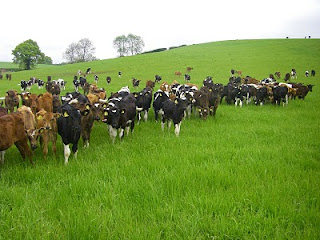
PS The photo at the top of this blog is NOT of Brookfield Farm but rather real live pasture grazing action from the Ankle Deep Discussion Group in Gloucestershire....just like in "The Archers".

I've just visited the best known dairy farm in England.....Brookfield Farm, Ambridge. Millions of listeners to BBC Radio 4 "The Archers" tune in either to the daily broadcast or online across the world to listen to what David & Ruth Archer are doing on their dairy farm.


"The Archers" first broadcast on 1st January 1951 is now the longest running radio soap in the world (over 16000 episodes). "The Archers" was created from radio programs during the WW2 that were broadcast to help farmers to produce food both during & post war.
I had the privilege to meet Tim Bentinck the actor who plays David Archer.


Tim I can tell you is a great guy with a quick wit & good humour. He has a genuine interest in farming firstly being born on a sheep station in Tasmania & secondly having family faming interests & connections in England.

I work with Graham Harvey who is the Agricultural editor for "The Archers", we are keen to include pasture grazing excellence into the program & highlight some of the innovative on farm practices from the Discussion Groups. Graham has also written "The Carbon Fields" book which is about the benefits of grass fed food & to the environment of pasture based farming. http://grassrootsfood.co.uk/

Working with Graham (& ofcourse David Archer) is a unique opportunity to speak to a much broader audience. Approximately 5 million people tune into the BBC Radio 4 each evening.....not only farmers but people who live in villages, towns & cities all over the UK....plus the online listeners. Every one given the opportunity needs to become an ambassador for their industry & profession. Grass fed milk farmers need to all become ambassadors for grass fed milk & the way in which you very efficiently farm.....if you don't or won't......then who will?Graham kindly arranged the visit to the BBC studios at Birmingham. It was very interesting to watch Kate the producer, the technical staff & actors rehearse & record another episode to go to air shortly. Thank you Kate.
One of the current story lines is related to the use of dairy bred calves being used for beef. The day after I visited Brookfield Farm I made a visit to Cheshire with the Turf Accountants Discussion Group to see a young farmer rearing dairy bred beef on a grass based system. It was very successful efficient production of healthy beef. So the Archers really are up with the game!

As to "The Archers" episode we watched being recorded...

what happened?.................You may ask that .........I could'nt possibly comment!

Monday, 19 April 2010

Launching My Very Own Manifesto.....Just for Fun


I've decided to run for President of the United Kingdom. Yes I know there isn't a vacancy but I'm proposing to have a chat with the Queen......maybe she would be happy to be the 'Monarch of the Glen' after I take office?

To revive interest in Westminster I propose bringing back public executions....starting with MPs who fiddled their expenses, then say past PMs & Business Secretaries. These events could be sold to TV & perhaps auctioned off.....I feel this could be bigger than Ben Hur.....& will probably solve our national debt problems.

At a local level.......I'd like to see the "Stocks" re built in all villages.........this could smarten up the performance of your local MP & would almost certainly ensure that MPs didnt seek a second term.

I'd abolish the House of Lords & replace with the "House of Comedians"


I want to make some real changes to the political landscape. Firstly I'm prepared to offer the three main parties each 50 seats. The total number of parlimentarians will be halved with the remaining seats offered to a wide range of independents. This will I imagine avoid a hung parliment.

I want to allow some sectors of the population extra votes......so if you live in rural GB you would get 2 votes, farmers who produce food will be given the right to have 3 votes. If you produce grass fed milk or beef this would allow you a further 3 votes i.e. 8 votes in total. This should even up the political power in GB.

I would halve the number of public servants in Year 1 & in Year 2. These fine people would be re allocated work to fix the pot holes in English roads. Starting with country roads & lanes.


This will keep them very busy (especially in rural England) at least until the economy improves. Once they have fixed the millions of pot holes they can start on broken drains & ragwort pulling. (This is part of my environmental manifesto....the photo below is of a broken water pipe in my county that has been in this state for months..lets assume the leak is flowing at 10 litres/minute then the losses of water amount to 14,400litres per day & over 400,000 per month.....outrageous in a world that has insufficient fresh water!)


All MPS would also serve in the armed services. This should reduce the number of armed conflicts our elected MPs vote for in the future.


My main Manifesto platform is to 'Ban Road Cones'......yes that's right.....those little orange critters are a public menace.....that come out onto the Motorways in England during the night. They apparently indicate that speed cameras are now in operation & also that the proposed roadworks haven't started yet & no one has any idea of when they will be completed! Once some Road Cones are out on the road they very successfully multiply out of control.....they have to be stopped!
Speed cameras would be eliminated immediately I took office.

I would replace all current motorcars with modernised Morris Minor & Austen Mini s.....this would regenerate British manufacturing & lower the Carbon Footprint.

While I'm ranting about my motorway policies.....I would ban all current drivers of black BMWs for life to make roads a much safer place for Dairy Consultants!


Aaaarh!.... What it is to be bored by endless hours on the motorway & listening to an extremely boring election. I was going to sort the airline business & food security but it seems the Icelandic volcano has beaten me to it. Mind you if I ever meet the bosses of the guys with the white paint brushes!!!??!??
If I haven't won you over yet I'm proposing that 'Joanna' succeed me (after I've gotten rid of the Road Cones.....in a succession plan.....you understand!